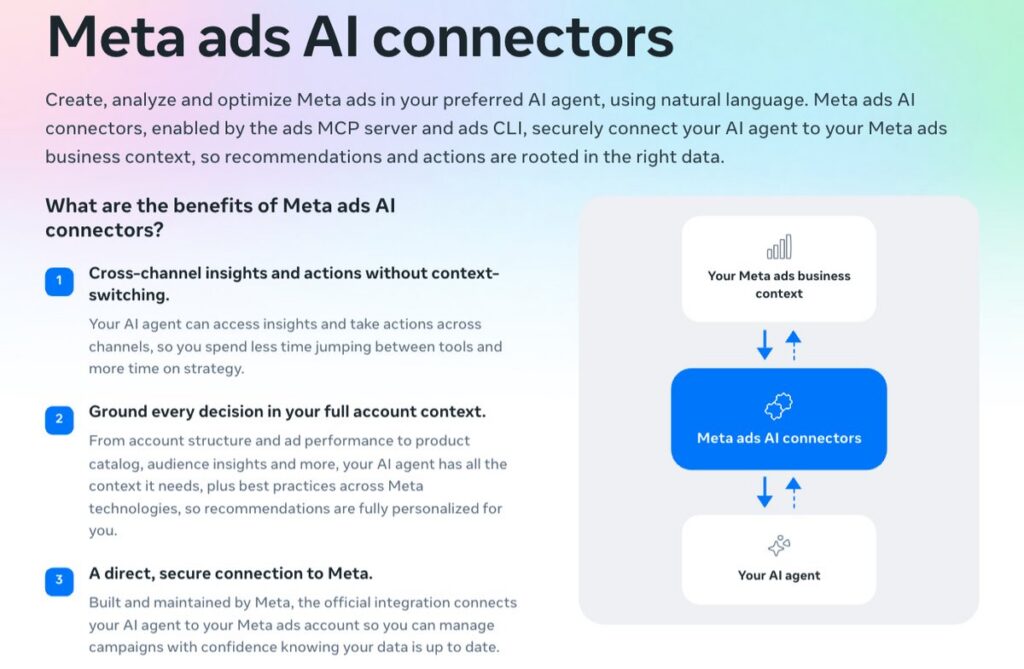
Meta is expanding its AI advertising strategy beyond its own ecosystem, launching new AI connectors that allow advertisers to manage and analyse Meta campaigns through external AI assistants and agent platforms including ChatGPT, Claude and Perplexity.
On the surface, the announcement looks like a workflow update. In reality, it signals something much bigger about where ad platforms, AI agents and marketing operations are heading.
The new Meta ads AI connectors allow brands and agencies to securely connect Meta ad accounts to third-party AI systems without requiring API setups, coding or developer credentials. Marketers can ask natural language questions inside their preferred AI assistant and receive responses grounded in live Meta campaign data, rather than generic recommendations.
For marketers increasingly working across fragmented platforms, dashboards and AI tools, the appeal is obvious. Yet the announcement also highlights a broader shift taking place across the advertising industry: AI is rapidly becoming the operating layer for digital marketing itself.
It may also raise longer-term questions around how client and agency relationships evolve as AI becomes more deeply embedded into campaign management.
Meta’s Bigger AI Advertising Vision
The launch of AI connectors fits into a much broader direction Meta has been signalling for some time.
Back in 2025, reports emerged that Mark Zuckerberg wanted Meta’s advertising systems to eventually automate the ad process end-to-end using AI by the end of 2026.
In interviews, Zuckerberg described a future where businesses simply provide a product, an objective and a budget, while Meta’s AI handles everything else, from creative generation and targeting through to optimisation and measurement.
At the time, many across the advertising industry viewed those comments as ambitious long-term positioning. Yet Meta’s latest announcements suggest the company is steadily building the infrastructure required to move closer towards that vision.
The connectors effectively turn external AI assistants into operational layers sitting directly on top of Meta’s ad systems.
That matters because it changes the role AI plays in advertising. AI is no longer simply helping marketers generate copy or summarise reports. It is increasingly becoming the interface through which campaigns are created, managed and optimised.
AI Is Becoming The Marketing Interface
Meta’s new connectors effectively turn AI assistants into campaign management environments.
Rather than navigating Ads Manager manually, marketers can create campaigns, edit ad sets, troubleshoot catalogues, analyse performance and pull reports directly through conversational prompts.
Historically, ad management required deep platform knowledge and increasingly complex workflows. AI interfaces reduce much of that friction by allowing marketers to work conversationally instead of operationally.
The long-term implication is that the interface itself becomes less important than the intelligence layer sitting above it.
Meta appears to recognise that reality. Instead of forcing advertisers to stay inside Meta AI, the company is meeting users where they already work, whether that is ChatGPT, Claude or another AI assistant.
That approach reflects a growing understanding across the industry that marketers are unlikely to rely on a single AI ecosystem.
Cross-Platform AI Workflows Are Emerging
One of the more significant aspects of the announcement is Meta’s emphasis on cross-channel flexibility.
The company positioned its AI connectors as complementary to broader marketing workflows, allowing advertisers to manage campaigns across publishers and integrate Meta insights into wider reporting systems.
That could become increasingly valuable as AI agents evolve into centralised marketing assistants capable of managing activity across multiple channels simultaneously.
For agencies especially, the ability to unify campaign analysis and execution across platforms inside a single AI workflow could significantly improve efficiency.
The shift also reflects a growing competitive reality among major platforms. AI capability is no longer simply about who builds the best chatbot. It is increasingly about who integrates most effectively into the marketer’s day-to-day workflow.
Notably absent from Meta’s launch partners is Microsoft Copilot, despite its growing importance within enterprise environments. Many large organisations are already standardising around Copilot through existing Microsoft 365 relationships, meaning interoperability with enterprise AI ecosystems could become an increasingly important consideration as AI-native marketing workflows mature.
AI Agents Are Moving Closer To Execution
Another notable aspect of Meta’s announcement is how far AI agents are moving beyond reporting and recommendations.
The connectors support write capabilities for campaign creation, ad management and catalogue management, meaning AI agents can not only analyse data but also perform actions on behalf of users once authorised.
That represents another step towards agentic advertising systems where AI handles increasingly large parts of campaign execution.
For marketers, the benefits are clear. Faster optimisation, simplified workflows and reduced operational overhead could all improve efficiency, particularly for smaller teams managing growing channel complexity.
At the same time, the shift introduces new considerations around oversight, governance and strategic control.
As AI agents become more embedded into campaign management, marketers may spend less time executing tasks manually and more time validating outputs, setting objectives and guiding strategic direction.
What Does It Mean For Agencies?
The rise of AI-native campaign management could also reshape expectations between brands and agencies over time.
Many traditional agency relationships have historically been built around executional expertise, platform knowledge and reporting. As AI tools reduce the complexity of campaign management, clients may begin questioning which parts of that work still require external support.
That does not necessarily reduce the value of agencies, but it may change where that value sits.
Execution is becoming increasingly automated across media buying, optimisation and reporting. Strategic thinking, creative development, audience insight and commercial guidance may become more important differentiators as AI absorbs more operational responsibility.
There is also a broader shift emerging around accountability and oversight.
Clients may increasingly expect agencies to operate as AI orchestration partners, helping businesses navigate fragmented AI ecosystems, validate AI-generated outputs and build governance frameworks around automation.
At the same time, AI could place pressure on traditional pricing models and perceptions of efficiency. If AI reduces the time required to execute campaigns, clients may increasingly scrutinise how agency value is measured.
The industry has experienced similar shifts before through automation and programmatic advertising, but AI agents could accelerate those changes much faster.
What It Means For Marketers
Meta’s AI connectors are ultimately less about convenience and more about where the advertising industry is heading next.
Several trends are becoming increasingly clear:
- AI interfaces are replacing traditional operational workflows
- Cross-platform AI management is becoming more important
- Marketing execution is becoming more automated
- Platforms are competing on interoperability as well as AI capability
- Agencies may need to reposition around strategy and advisory value
- AI-driven ad automation is accelerating towards end-to-end execution
That does not mean human expertise becomes less important. If anything, the opposite may be true.
As AI systems take over more operational tasks, differentiation is likely to come from strategy, creativity, positioning and decision-making rather than platform execution alone.
Meta’s latest announcement shows how quickly that transition is accelerating.
The future of digital advertising may not revolve around dashboards and interfaces in the way it once did. Increasingly, it may revolve around AI agents acting as the connective layer between marketers, platforms and performance itself.







RECOMMENDED FOR YOU
Google Gives Advertisers More AI Max Visibility
Google is introducing new AI Max reporting capabilities, giving…
Google is introducing new AI Max reporting capabilities, giving…
[STUDY] AI Content Production Keeps Accelerating
93% of marketers now use AI to support content…
93% of marketers now use AI to support content…
Meta Launches AI Agent For Businesses
Meta is extending its AI capabilities beyond Facebook, Instagram…
Meta is extending its AI capabilities beyond Facebook, Instagram…