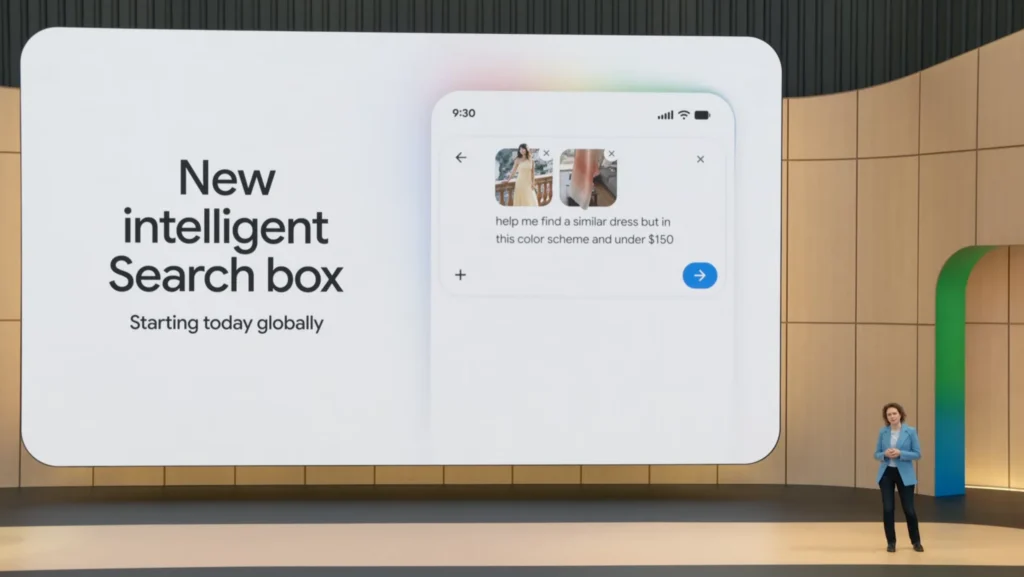
Google unveiled a sweeping set of AI Search updates at its Google I/O developer conference last week, centred around a redesigned Search box, conversational AI experiences and a new generation of Search agents powered by Gemini 3.5 Flash.
For businesses and marketers, the bigger story is not necessarily the technology itself, but what it signals about the future of Search.
As Google continues building a more self-contained AI Search experience, concerns around declining referral traffic are likely to intensify. Many publishers and brands have already reported falling organic traffic since the rollout of AI Overviews in 2024 and AI Mode in 2025. These latest updates suggest Google is continuing to push users deeper into its own ecosystem rather than out towards third-party websites.
At the same time, search behaviour itself is changing rapidly. Users are moving away from short keyword searches towards longer, conversational prompts and task-based interactions. That shift is likely to continue reshaping how visibility works within Search, forcing marketers to rethink how content is created, structured and optimised for AI-driven discovery.
Google is calling the redesigned interface its biggest Search box update in more than 25 years. That claim is open to interpretation, given how dramatically Search has evolved over the past two decades. Even so, the announcements represent another major step in Google’s transition from a traditional search engine towards an AI-powered assistant.
Search Is Becoming More Closed
One of the clearest themes from Google’s announcements is the continued expansion of its own AI environment.
The company is further integrating AI Overviews with AI Mode, allowing users to move seamlessly from AI-generated summaries into conversational search sessions without leaving Google’s interface.
New Search agents push that idea even further. Rather than simply surfacing information, Google’s AI systems are increasingly designed to monitor, recommend and complete tasks on behalf of users.
Examples shown at Google I/O included AI agents that track apartment listings, monitor product launches and even contact local businesses for bookings and services.
For users, the experience may feel more convenient and efficient. For publishers and marketers, however, the implications are more complicated.
As AI-generated responses become richer and more comprehensive, users may have fewer reasons to click through to external websites, particularly for informational queries. That trend has already become a growing concern across the publishing and SEO industries over the past year.
The latest updates suggest Google has little intention of reversing direction.
Search Behaviour Is Changing Fast
The redesign of the Search box itself may seem cosmetic at first glance, but it reflects a broader behavioural shift.
Google is actively encouraging users to search differently. Longer prompts, conversational interactions and multimodal inputs are becoming central to the Search experience.
Instead of typing fragmented keywords, users are increasingly asking Search complete questions, providing context and expecting AI-generated guidance in return.
That evolution matters because it changes how relevance is determined.
Traditional SEO strategies have largely been built around ranking for identifiable keyword patterns. AI-powered search experiences are more fluid, contextual and intent-driven, meaning the signals influencing visibility are likely to continue evolving.
Content strategies built purely around keyword targeting may become less effective over time if they fail to address broader user intent, topical authority and structured accessibility.
For marketers, adaptability is becoming increasingly important.
Visibility Still Matters, But The Rules Are Shifting
Despite growing concerns around traffic declines, opportunities still exist for businesses that evolve alongside Search.
Google’s AI systems still require trusted, authoritative and accessible information sources. Brands with strong expertise, well-structured content and clear topical relevance are still likely to benefit from visibility within AI-generated experiences.
However, success metrics may need to evolve.
Search visibility may no longer translate as directly into website clicks as it once did. Brand exposure, citation presence and influence within AI-generated answers could become increasingly important alongside traditional traffic metrics.
That may also require a shift in stakeholder expectations.
Organic search performance has historically been measured heavily through clicks, sessions and rankings. As AI Search continues to evolve, marketers may need to educate internal teams and clients that visibility and influence inside AI ecosystems will not always produce the same traffic patterns seen in previous years.
The broader challenge is that Search itself is becoming less passive.
Google’s announcements point towards a future where Search does not simply retrieve information, but actively interprets intent, maintains context and completes tasks. As those capabilities expand, ranking factors and optimisation strategies are likely to keep changing alongside user behaviour.
The Industry Will Need To Adapt
Several long-term trends are becoming increasingly difficult to ignore:
- AI-generated answers are becoming more prominent
- Conversational search behaviour is accelerating
- Google is keeping more interactions within its own ecosystem
- Search is evolving into a task-completion platform
- Traditional referral traffic patterns are becoming less predictable
- Content strategies are becoming more closely tied to AI discoverability
That does not mean SEO disappears. Nor does it mean independent websites become irrelevant.
Strong brands, trusted expertise and genuinely useful content will still matter. Businesses that understand how AI systems interpret, structure and surface information may still uncover significant opportunities for visibility and traffic growth.
However, the expectations surrounding Search performance are likely to continue changing.
Sundar Pichai described Search as evolving from “individual queries to ongoing conversations and now to agentic workflows”.
That framing may ultimately be the most important takeaway from Google’s latest announcements. Search is no longer just about directing users to information. Google is positioning it as an AI assistant designed to keep users inside an increasingly intelligent, self-contained ecosystem.























RECOMMENDED FOR YOU
Google Gives Advertisers More AI Max Visibility
Google is introducing new AI Max reporting capabilities, giving…
Google is introducing new AI Max reporting capabilities, giving…
[STUDY] AI Content Production Keeps Accelerating
93% of marketers now use AI to support content…
93% of marketers now use AI to support content…
Meta Launches AI Agent For Businesses
Meta is extending its AI capabilities beyond Facebook, Instagram…
Meta is extending its AI capabilities beyond Facebook, Instagram…