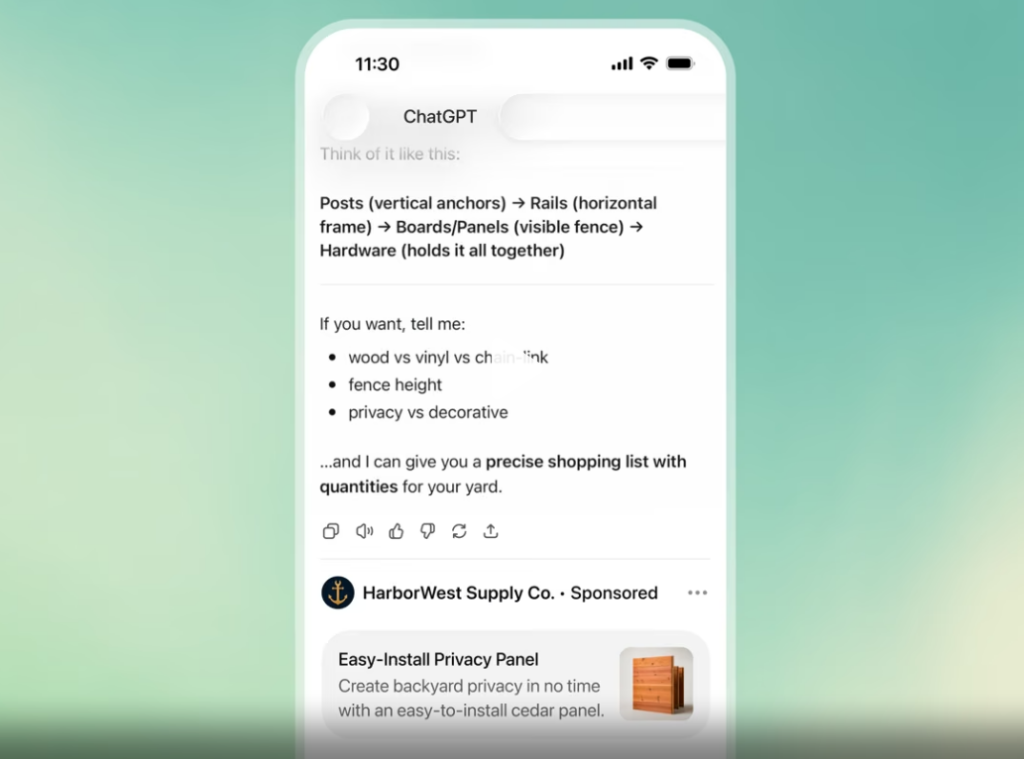
OpenAI is taking a major step toward turning ChatGPT ads into a scalable advertising platform, introducing self-serve campaign buying, CPC bidding, and improved measurement capabilities.
Until now, ChatGPT advertising has operated as a tightly controlled pilot programme, largely limited to major brands and agency partners. The latest updates signal a shift toward broader adoption, opening the ecosystem to more advertisers while moving the platform closer to established digital advertising models.
For marketers, the expansion marks an important moment in the evolution of AI-powered advertising.
ChatGPT Ads Move Beyond Pilot Phase
OpenAI first launched ChatGPT ads through direct partnerships with a small group of advertisers, using a highly managed approach to test demand, performance, and user experience.
That model is now evolving.
Advertisers can access ChatGPT inventory through agency and technology partners including WPP, Publicis, Omnicom, Dentsu, Adobe, Criteo, Pacvue, and StackAdapt. Alongside those partnerships, OpenAI is also rolling out a beta self-serve Ads Manager for US advertisers.
The move follows a familiar platform growth strategy. Many major ad platforms begin with high-touch managed campaigns before introducing self-serve tools that support wider adoption and revenue scale.
ChatGPT is now entering that next phase.
OpenAI Launches Self Serve Ads Manager
The new Ads Manager gives advertisers direct control over campaign setup and management within ChatGPT.
Businesses can create advertiser accounts, upload creative assets, manage budgets, adjust bidding strategies, track pacing, and monitor performance directly through the platform.
Although still in beta, the launch represents a significant development for smaller advertisers and emerging brands.
Access to ChatGPT ads has previously been expensive and operationally restrictive, creating a high barrier to entry for SMBs and startups. Self-serve tools reduce that friction considerably.
More importantly, the rollout signals OpenAI’s intention to build a long-term advertising ecosystem rather than relying solely on agency-led activation.
As adoption grows, marketers should expect OpenAI to continue expanding campaign objectives, targeting capabilities, and creative formats.
CPC Bidding Brings Performance Focus
One of the biggest changes within the update is the introduction of cost-per-click bidding.
During the initial pilot phase, ChatGPT ads were sold on a CPM basis, meaning advertisers paid primarily for impressions. OpenAI is now adding CPC buying, allowing marketers to optimise around clicks and user actions instead.
That change moves ChatGPT closer to traditional performance advertising environments such as Google Ads and Meta Ads.
It also reflects the unique nature of ChatGPT user behaviour.
Unlike passive social scrolling, ChatGPT interactions are often highly intentional. Users frequently enter exploratory, comparison-based, or decision-driven conversations where commercial intent can emerge naturally.
Someone researching software providers, comparing travel options, or evaluating business tools may already be deep within the consideration stage of the customer journey.
In those scenarios, a click can become a strong signal of relevance and purchase intent.
For performance marketers, that creates new optimisation opportunities that were difficult to justify under impression-only pricing models.
OpenAI has confirmed that both CPM and CPC buying will remain available, with additional bidding and optimisation models expected over time.
Measurement Capabilities Continue To Improve
Measurement has been one of the biggest weaknesses in early ChatGPT advertising.
Without reliable attribution and conversion tracking, many advertisers struggled to evaluate campaign effectiveness or justify ongoing spend.
OpenAI is now addressing that challenge through the rollout of pixel-based tracking and a Conversions API.
The new tools allow advertisers to track downstream actions including purchases, sign-ups, leads, and other conversion events after users engage with ads.
Importantly, OpenAI is positioning measurement around aggregated reporting rather than individual-level user data.
Advertisers receive campaign performance insights without access to private conversations or personal user information. OpenAI continues to emphasise that ChatGPT responses remain independent from advertising systems and that conversations stay private.
That privacy-first positioning will likely remain central as OpenAI expands its advertising business.
At the same time, stronger measurement capabilities are essential for platform growth. Better conversion data improves optimisation systems, increases advertiser confidence, and allows campaigns to move beyond awareness-focused objectives.
For marketers already investing heavily in attribution infrastructure across search and social, the addition of conversion measurement makes ChatGPT ads significantly more viable as a test channel.
AI Search Advertising Is Expanding Quickly
OpenAI’s push into scalable advertising also reflects a wider industry shift.
Google has already started integrating ads into AI-powered search experiences through AI Overviews and AI Mode, signalling that conversational interfaces are becoming commercial environments across the search ecosystem.
Within AI Overviews, sponsored placements can appear alongside AI-generated summaries when Google determines commercial intent is present. The company has also begun testing advertising opportunities inside AI Mode, its more conversational search experience designed to compete more directly with platforms like ChatGPT.
That matters because AI search experiences fundamentally reshape how discovery happens.
Traditional search results pages are built around lists of links. Conversational AI environments, by contrast, compress research, comparison, and recommendation into a single interface. Users increasingly receive synthesised answers rather than navigating through multiple websites independently.
As a result, advertisers are now competing for visibility within AI-generated journeys rather than just search rankings or social feeds.
For marketers, the implications are significant.
AI-driven discovery environments may eventually blend elements of search, recommendation engines, and conversational assistants into a unified advertising model. Performance signals could become more contextual, with intent inferred from ongoing conversations rather than isolated keywords alone.
OpenAI’s latest ad expansion suggests the company sees that opportunity clearly.
AI Advertising Enters A New Phase
The broader significance of the update extends beyond OpenAI itself.
ChatGPT ads represent one of the first large-scale attempts to monetise conversational AI through advertising while maintaining a useful user experience.
That balancing act will shape how AI advertising evolves across the industry.
OpenAI has repeatedly stated that ads will remain clearly separated from ChatGPT’s generated answers rather than integrated directly into conversational responses. The company also continues to position user control and transparency as core principles within the ad experience.
Even so, marketers should expect ad formats to evolve rapidly over the next 12 to 24 months.
As conversational search behaviour grows, AI platforms may increasingly become environments where product discovery, comparison, and commercial decision-making take place in real time.
That creates new opportunities for brands willing to experiment early.
ChatGPT Ads Could Reshape Discovery
One of the most important long-term questions is how ChatGPT advertising changes digital discovery behaviour.
Traditional search advertising captures intent after users actively search for products or services. Social advertising often creates demand through interruption and targeting.
Conversational AI sits somewhere between the two.
Users engage with ChatGPT to solve problems, research ideas, and evaluate options through multi-step conversations. That context could create richer commercial intent signals than many existing advertising environments.
If OpenAI can scale measurement, maintain user trust, and improve ad relevance, ChatGPT ads could eventually become a meaningful performance channel rather than simply an experimental branding environment.
For now, the platform remains early-stage. Adoption, competition, pricing, and performance consistency are still developing.
Even so, OpenAI’s latest updates make one thing clear. ChatGPT advertising is moving from controlled experiment toward a fully operational ad platform.











RECOMMENDED FOR YOU
Google Gives Advertisers More AI Max Visibility
Google is introducing new AI Max reporting capabilities, giving…
Google is introducing new AI Max reporting capabilities, giving…
[STUDY] AI Content Production Keeps Accelerating
93% of marketers now use AI to support content…
93% of marketers now use AI to support content…
Meta Launches AI Agent For Businesses
Meta is extending its AI capabilities beyond Facebook, Instagram…
Meta is extending its AI capabilities beyond Facebook, Instagram…