
LinkedIn’s latest benchmark data points to a platform evolving far beyond professional networking. Engagement is rising, audiences are rewarding deeper content, and brands are adapting their publishing strategies to keep pace with changing user behaviour.
Based on an analysis of 1.3 million LinkedIn posts from more than 16,000 business pages, the 2026 benchmark report highlights a clear trend. Substance now outperforms surface-level publishing.
For marketers, the findings offer a valuable snapshot of what currently drives reach, engagement, and audience growth on LinkedIn.
LinkedIn Engagement Continues To Rise
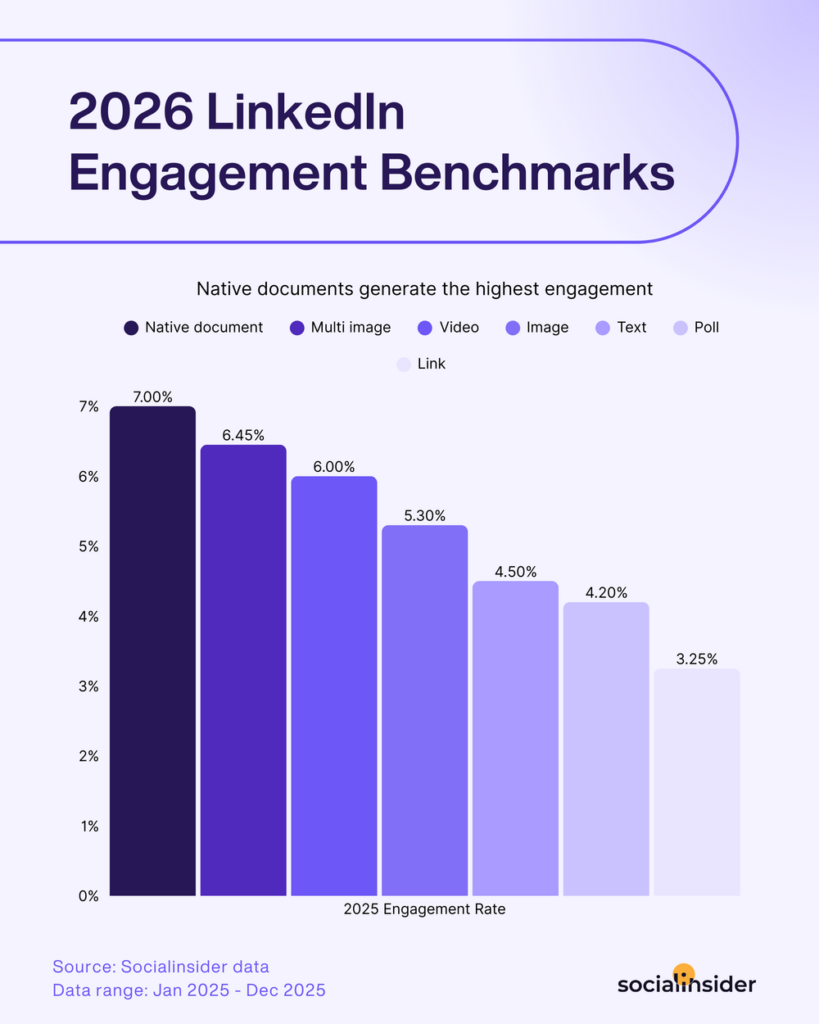
LinkedIn’s average engagement rate increased to 5.2% in 2026, marking an 8% year-on-year rise. Growth was visible across nearly every content format, signalling stronger user interaction across the platform.
Native document posts emerged as the strongest-performing format, achieving a 7% engagement rate and recording 14% annual growth. Video engagement rose by 7%, image posts increased by 9%, and text-only posts climbed by 12%.
Document posts are increasingly effective because they align with how users consume professional content on LinkedIn. Audiences are actively looking for practical resources, frameworks, templates, and insights they can save and revisit later.
Carousel-style documents also support stronger retention. Users spend longer swiping through slides, which increases interaction signals and encourages further distribution in the feed.
For brands investing in thought leadership, the data reinforces the value of educational content over promotional messaging.
Multi Image Posts Drive Stronger Interaction
Although native documents lead overall engagement, multi-image posts continue to perform exceptionally well for likes and impressions.
Across almost every follower category, multi-image posts generated the highest average likes per post. Larger pages saw particularly strong results, with accounts between 100K and 1M followers averaging 180 likes per carousel post.
The success of carousel-style publishing reflects a wider shift toward layered storytelling. Rather than delivering a single message in one frame, brands are using sequential content to build narrative and maintain attention.
LinkedIn users increasingly expect context, depth, and practical takeaways. Multi-image formats support all three while remaining highly digestible in-feed.
The format also offers strong repurposing opportunities. Existing blog posts, webinars, reports, and video transcripts can all be adapted into carousel content with relatively low production effort.
For marketers managing lean content teams, that efficiency matters.
Polls Deliver Reach At Scale
One of the more surprising findings from the report involves LinkedIn polls.
For pages with more than 50K followers, polls generated the highest average impressions of any content type. Large accounts between 100K and 1M followers saw polls average nearly 10,000 impressions per post.
Polls work particularly well because they lower the barrier to participation. Users can engage instantly without committing to a comment or share.
That interaction then signals relevance to LinkedIn’s algorithm, helping extend visibility beyond immediate followers.
Brands using polls effectively tend to focus on broad professional topics rather than niche technical questions. Audience feedback, industry opinions, and workplace trends all perform well because they invite participation from a wider group of users.
For growing brands, polls can also provide valuable content intelligence. Responses help identify audience priorities and emerging discussion themes that can inform future campaigns.
LinkedIn Video Views Decline
Despite LinkedIn’s ongoing investment in video features, the benchmark data reveals a significant decline in video performance.
Average video views dropped by 36% year on year across every follower bracket.
Even the platform’s largest pages experienced falling view counts, with accounts between 100K and 1M followers declining from 2,430 average views to 1,380.
The drop suggests LinkedIn still struggles to function as a true video-first environment.
Unlike TikTok or Instagram, LinkedIn lacks a discovery engine designed around passive video consumption. Users typically visit the platform with a more intentional mindset focused on learning, networking, and industry insight.
As a result, video content that simply replicates formats from other platforms often underperforms.
Marketers seeing stronger LinkedIn video results are generally adapting content specifically for the platform. Educational explainers, industry commentary, and practical walkthroughs tend to outperform highly polished social-first video formats.
Captions, clear summaries, and concise storytelling are also becoming increasingly important as users consume content in fast-moving professional feeds.
Posting Frequency Continues To Increase
The report also highlights a noticeable increase in publishing frequency across visual formats.
Brands doubled their average monthly video output from two posts to four, while image posting increased from five posts per month to seven.
Native document publishing also doubled year on year.
The increase reflects growing competition within the LinkedIn feed. As more creators and brands prioritise LinkedIn as a primary publishing channel, consistency is becoming increasingly important for maintaining visibility.
Higher posting frequency alone, however, is not enough.
Successful brands are combining consistency with format diversification, balancing educational carousels, thought leadership posts, polls, videos, and employee-generated content.
Many are also building internal content systems to sustain output efficiently, including reusable templates, content batching workflows, and collaborative idea banks.
Audience Growth Slows Across LinkedIn
While engagement is rising, follower growth is becoming harder to achieve.
Smaller pages between 1K and 5K followers still recorded healthy average growth rates of 24.5%, but larger pages experienced significant slowdowns.
Accounts with more than 100K followers saw growth decline sharply to just 6.4%.
The shift reflects broader changes across social media. Professional conversations now happen across multiple platforms, reducing LinkedIn’s dominance as the primary destination for career-focused content.
Employee-generated content, founder-led branding, and workplace storytelling increasingly appear across TikTok, Instagram, and YouTube alongside LinkedIn itself.
For marketers, sustainable LinkedIn growth now depends less on volume and more on relevance.
Brands seeing continued momentum are investing in recurring educational series, live events, collaborative campaigns, and employee advocacy strategies that extend reach beyond owned audiences.
Personal Profiles Still Matter
One important caveat within the report is that the benchmark data is based exclusively on LinkedIn business pages rather than personal profiles.
That distinction matters because executive accounts, founders, and employee creators often experience very different engagement dynamics compared to brand-owned pages.
Personal profiles generally benefit from stronger organic reach, more conversational engagement, and better visibility within LinkedIn’s network-driven algorithm. Text-led commentary, opinion posts, and behind-the-scenes updates frequently outperform more polished corporate publishing styles in those environments.
Even so, brands running employee advocacy programmes or executive personal branding strategies can still draw valuable insights from the findings.
The broader trends around educational content, carousel storytelling, audience participation, and publishing consistency remain highly relevant for experimentation across leadership and employee-led LinkedIn activity.
For many organisations, the strongest LinkedIn strategies now combine both approaches: a consistent brand page presence supported by credible employee and executive voices that amplify reach and engagement more organically.
LinkedIn Continues To Reward Valuable Content
The latest LinkedIn benchmarks point to a platform increasingly rewarding expertise, consistency, and practical value.
Document posts, carousels, and audience-driven discussions are outperforming generic promotional content. At the same time, brands relying heavily on recycled short-form video strategies may need to rethink their approach.
LinkedIn remains one of the few major social platforms where professional audiences actively seek learning opportunities. Marketers who prioritise useful, experience-led content are likely to see the strongest long-term results.
As competition increases and audience growth becomes more challenging, the brands winning on LinkedIn are increasingly those building trust rather than simply chasing visibility.








RECOMMENDED FOR YOU
LinkedIn Lets AI Multiply Ad Creative
LinkedIn is giving advertisers far more freedom to vary…
LinkedIn is giving advertisers far more freedom to vary…
LinkedIn Builds Its AI Search Advantage
LinkedIn is making a stronger case for its role…
LinkedIn is making a stronger case for its role…
[STUDY] LinkedIn Ads Influence More Than Leads
LinkedIn advertising remains expensive by most conventional performance measures.…
LinkedIn advertising remains expensive by most conventional performance measures.…