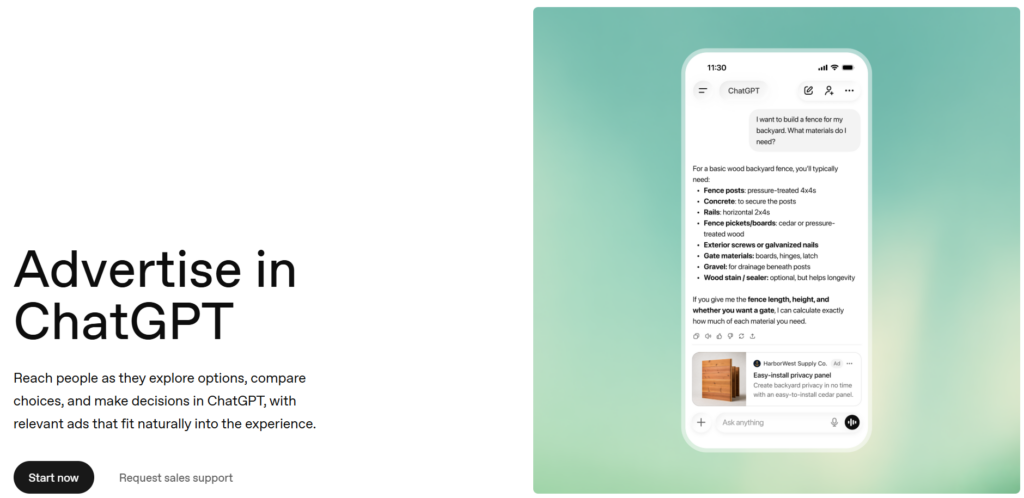
ChatGPT Ads has reached a US$1 billion annualised revenue run rate less than 200 days after launch, giving OpenAI an advertising business of meaningful scale far sooner than many would have expected.
The company says tens of thousands of advertisers are already using the platform, while self-service buying has now expanded across India, Europe, the Middle East and North Africa. OpenAI also positions advertising as one of four major revenue pillars alongside subscriptions, enterprise products and usage-based APIs.
The milestone matters beyond OpenAI.
Advertising is becoming one of the clearest commercial expressions of the wider AI shift across digital marketing. ChatGPT is building a new advertising environment around conversations, while Google and Meta are using AI more deeply across targeting, creative, delivery and campaign optimisation.
ChatGPT’s early growth suggests marketers are willing to start allocating meaningful money to that future well before the market has settled on exactly what AI-native advertising should look like.
Advertising Is Becoming Part Of ChatGPT’s Growth Model
OpenAI originally introduced advertising partly as a way of supporting broader access to ChatGPT.
Free and Go users can receive ads, while Plus, Pro, Business, Enterprise and Edu remain ad-free. With more than one billion people using ChatGPT each week, even a relatively small proportion of that audience represents substantial potential inventory.
That gives OpenAI an increasingly familiar digital platform model. A large free audience creates advertising inventory, while advertising revenue can help subsidise mass-market access and support further audience growth.
Subscriptions and enterprise products give OpenAI additional ways to monetise its most engaged users, so advertising does not need to carry the entire business.
That makes the US$1 billion run rate particularly interesting. ChatGPT Ads does not need to approach Google or Meta scale immediately to become strategically important to OpenAI. It simply needs to turn a fraction of ChatGPT’s enormous non-paying audience into valuable commercial inventory.
The speed at which advertisers have started testing the platform suggests there is already considerable demand to find out how valuable that inventory can become.
Some Categories May Fit ChatGPT Better Than Others
Early advertiser uptake is unlikely to be evenly distributed across the economy.
OpenAI’s current policies make consumer goods, travel, local services, education and digital products relatively straightforward categories for advertisers, while areas such as finance, healthcare and legal services are being introduced more cautiously and may require additional approval.
The format itself may also favour categories where people naturally spend time researching, comparing and explaining their requirements before making a decision.
Travel, software, education, local services and other considered purchases fit that pattern reasonably well because the user can describe what they need, refine the brief and compare alternatives over several exchanges.
ChatGPT may therefore develop quite differently from channels built around rapid impulse or habitual buying.
That matters when interpreting the US$1 billion run rate. OpenAI is not simply building another broad display network. Early growth is likely to be shaped by a combination of platform eligibility and how naturally different categories fit conversational decision making.
As access broadens and new formats develop, the advertiser mix should widen with it.
ChatGPT Introduces A Different Kind Of Intent
OpenAI’s potential advantage lies in the context surrounding the advertisement.
Search engines have historically inferred intent from queries, while social platforms infer it from behaviour, interests, relationships and content engagement.
ChatGPT users can describe much more complicated needs.
Someone might explain their budget, circumstances, priorities, previous experience and concerns over several exchanges before reaching a commercial decision.
OpenAI’s Context Hints system is designed around that environment. Advertisers describe the conversations and situations where their offer may be relevant rather than relying entirely on conventional keywords. Ads can then be matched against the wider conversational context.
A well-matched advertisement could therefore appear at a point where the system understands considerably more about what someone is trying to achieve than a conventional three-word search query might reveal.
The model also creates a new challenge because relevance becomes more contextual and potentially harder to manage than familiar keyword or audience targeting.
OpenAI is already adding more conventional advertising capabilities alongside conversational targeting, including custom audiences, conversion optimisation, geo-targeting and its own Pixel and Conversions API.
Over time, the strongest campaigns may combine both models, using first-party audience signals to understand who matters while conversational signals identify when a particular message is relevant.
AI Is Changing The Advertiser’s Job
The wider shift across ChatGPT, Google and Meta is also changing what advertisers are expected to contribute.
Historically, digital media expertise often centred on operating the platform. Teams built detailed targeting structures, managed keywords, selected placements, adjusted bids and continually optimised campaigns manually.
Platforms increasingly want something different.
Meta wants better creative, stronger customer signals and clearer objectives while its systems handle more targeting and delivery.
Google increasingly asks advertisers to provide strong landing pages, product data, creative assets and business constraints while systems such as AI Max determine how to capture emerging search demand.
ChatGPT asks advertisers to understand the situations and conversations where their product genuinely belongs.
In each case, expertise moves away from manipulating every individual media setting and towards providing better inputs, designing stronger experiments and judging the quality of the outputs.
That could make marketing strategy more important rather than less.
AI systems can optimise against the information and objectives they receive. They cannot compensate indefinitely for weak positioning, poor creative, bad customer data or an offer that people do not particularly want.
AI Advertising Is Still At The Beginning
OpenAI’s own ambitions for advertising are substantial.
Reported internal projections put ad revenue at around US$2.5 billion in 2026, with much larger numbers expected later in the decade. The US$1 billion annualised run rate puts OpenAI meaningfully along that first-year trajectory.
There is no need to assume every long-term forecast will be reached for the current milestone to matter.
Google and Meta have spent decades building the data, tools, agency ecosystems and advertiser expertise that support their advertising businesses today. ChatGPT Ads has existed for roughly six months.
OpenAI is therefore not entering a mature market with a finished product. It is entering a mature advertising industry with a new environment for commercial intent.
That distinction gives larger advertisers a reason to experiment even while the channel continues evolving.
The benefit is not simply the possibility of finding another source of conversions. Early participation gives marketing teams experience with conversational targeting, AI-native creative, new measurement approaches and a media environment that may behave quite differently from search and social.
ChatGPT’s US$1 billion run rate shows that enough advertisers already see value in beginning that process.
The bigger story is that AI advertising is no longer one product category sitting alongside digital media. Across OpenAI, Google and Meta, it is becoming part of the operating system of digital advertising itself.







RECOMMENDED FOR YOU
Google Gives Advertisers More AI Max Visibility
Google is introducing new AI Max reporting capabilities, giving…
Google is introducing new AI Max reporting capabilities, giving…
[STUDY] AI Content Production Keeps Accelerating
93% of marketers now use AI to support content…
93% of marketers now use AI to support content…
Meta Launches AI Agent For Businesses
Meta is extending its AI capabilities beyond Facebook, Instagram…
Meta is extending its AI capabilities beyond Facebook, Instagram…