
Brands are in for a YouTube performance windfall from this week.
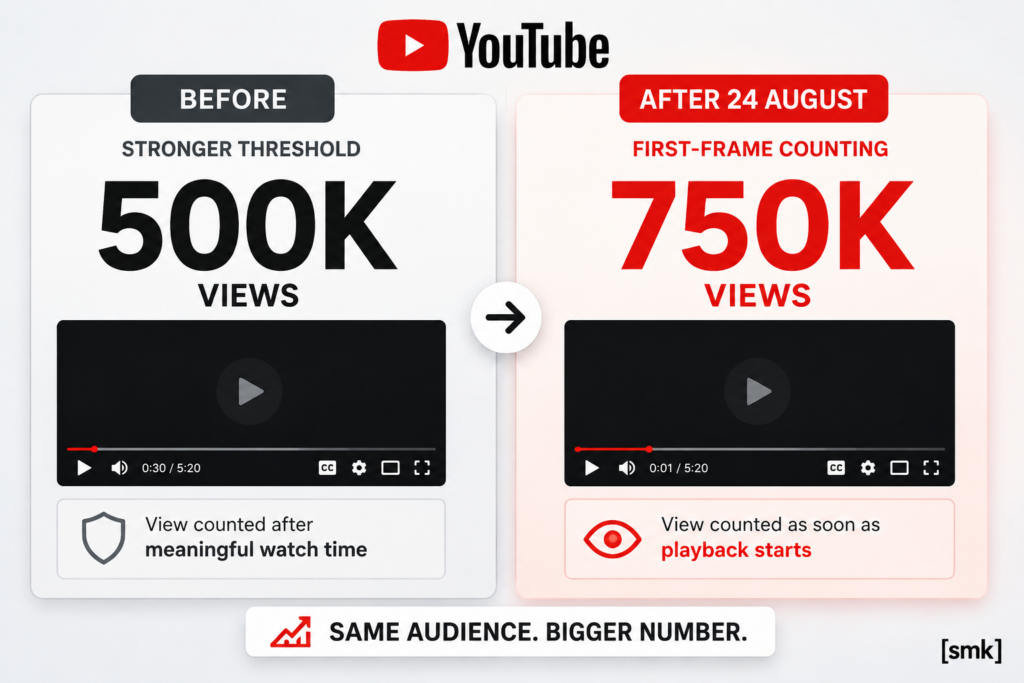
From 24 August, YouTube is extending the first-frame view methodology already used for Shorts across long form video, podcasts and Live. A video beginning to play will now count as a view, bringing more of YouTube into line with the reporting conventions marketers already know from TikTok, Instagram Reels and Facebook video.
For many brands, that should mean bigger numbers.
Nothing about the audience necessarily changed. The content did not suddenly improve, and people did not suddenly start watching for longer. YouTube changed the way exposure is counted.
That matters because YouTube will now look better in the same dashboards, reporting packs and channel comparisons where it has often been measured against platforms using more generous definitions of a view.
Shorts Made The Move First
Since 31 March 2025, Shorts views have counted whenever a Short starts to play or replay, with no minimum watch time requirement. YouTube retained the previous measure separately as an engaged view, showing how many viewers chose to continue watching.
That brought Shorts closer to the measurement conventions already used across short form social video.
Now the rest of YouTube is moving in the same direction.
At headline level, the change creates a more consistent definition across Shorts, long form, podcasts and Live. It also makes YouTube easier to compare with the wider social video market.
For marketers used to placing YouTube alongside Instagram, Facebook and TikTok in the same report, the effect could be immediate.
The Uplift Will Be Partly Statistical
A brand generating 500,000 YouTube views before the change could see a materially higher number afterwards without attracting a single additional viewer.
That has real consequences because headline metrics shape perception. Bigger numbers can make campaigns look stronger internally, improve creator reporting and influence how channels stack up when budgets are being compared.
There is also a reasonable argument that YouTube has been underselling itself.
If competing platforms give brands credit for lighter-touch exposure while YouTube applies a higher viewing threshold, then the resulting view totals were never truly comparable.
Bringing YouTube closer to the wider market may therefore level the playing field.
It also exposes a broader weakness in social video measurement.
If a first-frame exposure now feels like a generous definition of a YouTube view, marketers should ask what they have really been measuring on Instagram, Facebook and TikTok all along.
Views Tell You Reach, Not Attention
A view increasingly tells you that playback started.
It tells you much less about whether the content worked.
The more useful story begins after the first frame.
On YouTube, watch time and retention remain central to performance. The platform uses engagement and viewing behaviour to understand whether audiences are finding content useful and whether it deserves wider distribution.
The same principle applies across TikTok, Reels and other video platforms.
Getting someone to start watching is only the first hurdle. The engine room is what happens next.
For brands, average view duration, percentage viewed, retention curves and engaged viewing therefore tell a much fuller story than the headline view count.
A piece of content with fewer starts can still be doing a better job if it holds people for materially longer.
Reporting Needs A Clean Break From 24 August
Any organisation using YouTube views as a benchmark should mark 24 August 2026 as a methodology change.
Pre and post-change numbers should not be treated as directly comparable without qualification.
Monthly and quarterly reporting may need a note. Creator benchmarks may need resetting. Agencies should be cautious about presenting a jump in views across the change as pure performance growth.
Brands working with creators should also be clear about which metric sits behind performance reporting.
A creator delivering one million views may have produced substantial attention. They may also have produced one million starts followed by weak retention.
Once the headline metric becomes easier to generate, the quality of that attention matters more.
YouTube Needs Its Scale To Work Harder Commercially
The timing is interesting because YouTube has a wider commercial challenge.
It remains one of the biggest and stickiest video platforms in the world. It generated more than $60 billion in total revenue in 2025, including $40.4 billion from advertising, while Shorts now generate more than 200 billion daily views.
Yet advertising growth has been slowing.
WARC forecasts that TikTok could overtake YouTube in global advertising revenue by 2030, driven partly by its ability to attract performance and social commerce budgets.
Given YouTube’s scale, that is a striking prospect.
The issue is not that marketers dislike YouTube. WARC says it has been the most preferred and trusted media brand among marketers globally for three consecutive years.
The gap is between that strong position and YouTube’s ability to turn its enormous audience into advertising growth at the same rate as some of its social competitors.
Seen through that lens, the view change fits into a wider pattern.
YouTube has spent several years building Shorts, expanding creator tools, strengthening commerce capabilities and making the platform behave more like the social environments competing for the same budgets.
Bringing headline video measurement closer to TikTok, Instagram and Facebook is another part of that shift.
From this week, YouTube may look stronger in the same reports where those platforms have historically benefited from more generous view definitions.

























RECOMMENDED FOR YOU
Instagram Looks Beyond Short Form Video
Instagram is preparing for a future where short-form video…
Instagram is preparing for a future where short-form video…
Google Expands AI Search To YouTube
Google is testing a new AI-powered search experience within…
Google is testing a new AI-powered search experience within…
YouTube Dominates AI Search Results With 200x Advantage
YouTube may be one of the best-kept secrets for…
YouTube may be one of the best-kept secrets for…