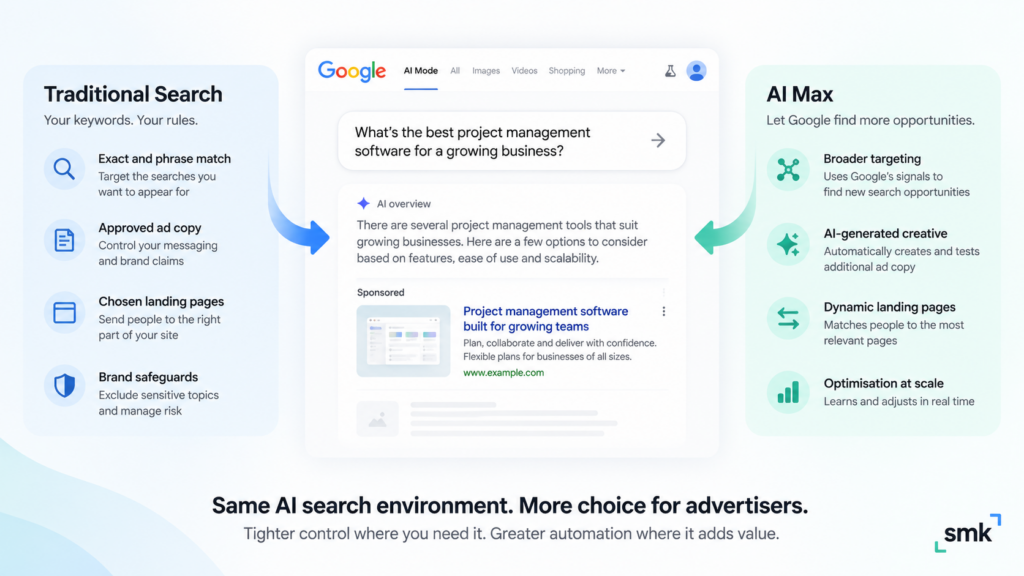
Google is testing a more controlled route into AI Mode, allowing text ads from traditional Search campaigns using exact and phrase match keywords to appear when user intent is sufficiently clear.
Google has been steadily pushing more of Search advertising towards AI-led targeting, matching and creative. AI Max can expand beyond an advertiser’s existing keyword list, use broader account and landing-page signals, generate additional copy and choose different landing pages based on predicted intent.
Plenty of advertisers are comfortable with that level of automation.
Large brands, regulated organisations and experienced performance teams often are not.
They may need tighter control over approved messaging, brand claims, landing pages, search terms and the contexts in which ads appear. More advanced advertisers may also want to challenge Google’s optimisation decisions rather than assume that additional reach automatically means better business outcomes.
Google’s latest AI Mode test gives those advertisers another option.
Traditional Search campaigns can potentially reach users inside Google’s conversational search experience while retaining more of the controls that already exist around exact and phrase match keywords.
AI Mode Is Opening Up To More Advertisers
AI Mode changes how people search.
Instead of typing a short query, scanning a page of links and starting another search, users can explore a subject through a longer conversation. Questions become more detailed, Google generates answers and commercial intent can emerge gradually.
Someone planning a holiday might start by comparing destinations, then move into neighbourhoods, accommodation types and eventually a specific search for a family hotel in Broadbeach.
The journey looks different, but the commercial intent is still recognisable.
Google is now testing whether traditional Search ads can enter those moments when the query maps closely enough to an advertiser’s exact or phrase match keywords.
Advertisers therefore may not need to move entirely into AI Max or Performance Max to gain some visibility inside AI Mode.
Corporate Brands Have Good Reasons To Want Control
Automation can identify opportunities that a manually managed account may miss.
It can also create problems when the brand operates under stricter rules.
A bank may have approved wording around financial products. A university may want different landing pages and messaging for particular courses. A government organisation may need to avoid certain claims entirely. Major consumer brands may have tightly controlled language around pricing, sustainability, health or product performance.
AI-generated copy and broader query matching introduce more variables into those environments.
Google has added controls around AI Max, including text guidelines, brand settings and the ability to switch some AI features off. The wider direction still gives Google considerably more discretion than a tightly managed keyword campaign.
For some advertisers, that freedom is useful.
For others, control remains part of brand governance rather than simply a media buying preference.
Advanced Advertisers Still Challenge The Machine
More experienced paid search teams also tend to scrutinise automation more closely.
Google’s systems optimise towards the objectives and conversion signals advertisers provide. Those signals are not always a perfect representation of commercial value.
A campaign can generate more reported conversions while attracting poorer-quality leads.
Broader matching can uncover useful searches that were missing from the account. It can also move spend into marginal queries that an experienced team would have excluded.
Automated creative can improve relevance. It can also produce copy that is technically accurate but weaker from a brand or strategic perspective.
Google’s incentives deserve scrutiny too. The platform benefits when advertisers find more places to spend.
None of that makes automation inherently bad. It does make human oversight valuable.
Experienced teams increasingly need to decide where Google should have freedom and where the potential cost of wasted spend, poor-quality demand or inappropriate messaging outweighs the benefit.
Keywords Still Have A Role In AI Search
Conversational search has sometimes been presented as the beginning of the end for keywords.
Google’s test suggests a more complicated outcome.
A user may ask a long sequence of questions inside AI Mode, but eventually arrive at a need that maps closely to a conventional commercial search.
At that point, an exact or phrase match keyword can still provide a useful signal.
Traditional Search campaigns can handle clearly defined, high-intent demand while AI Max and other automated systems explore broader or less predictable opportunities.
That gives advertisers more flexibility over how different types of demand are managed.
A Hybrid Model Makes More Sense
Large accounts rarely need one campaign philosophy applied everywhere.
Some categories, products and searches benefit from broad automation.
Others need tighter control because the commercial value is higher, the brand risk is greater or the messaging requirements are more restrictive.
Google’s AI Mode test points towards a hybrid model.
Advertisers can allow AI Max to explore incremental demand while protecting more sensitive areas through traditional Search structures.
Exact and phrase match campaigns could continue handling high-value or closely governed intent. AI-led campaigns could operate more freely where the organisation has greater tolerance for experimentation.
That gives advanced advertisers more choice without keeping them outside AI Mode altogether.
It also gives Google a route to monetise AI search without requiring every advertiser to adopt the same level of automation.
Control Still Needs To Be Real
Google has not disclosed how widely the test is running, how much AI Mode inventory traditional Search campaigns can access or how performance will ultimately be reported.
Auction behaviour will also need watching if traditional Search, AI Max and Performance Max can all become eligible around similar commercial intent.
Advertisers will need enough visibility to understand where ads appeared, which queries triggered them and how that traffic performed.
Exact and phrase match only provide meaningful reassurance if they continue to give advertisers genuine steering over the searches they enter.
Google has spent years encouraging advertisers to trust its automation.
Giving brands more ways to participate without surrendering every control may prove a better route into AI search.











RECOMMENDED FOR YOU
Google Gives Advertisers More AI Max Visibility
Google is introducing new AI Max reporting capabilities, giving…
Google is introducing new AI Max reporting capabilities, giving…
[STUDY] AI Content Production Keeps Accelerating
93% of marketers now use AI to support content…
93% of marketers now use AI to support content…
Meta Launches AI Agent For Businesses
Meta is extending its AI capabilities beyond Facebook, Instagram…
Meta is extending its AI capabilities beyond Facebook, Instagram…