LinkedIn is making a stronger case for its role in AI search, backed by new Semrush research showing that the platform is already appearing regularly in answers from ChatGPT Search, Google AI Mode and Perplexity.
The study analysed 325,000 prompts across 12 industry categories during January and February 2026, then examined around 89,000 unique LinkedIn URLs cited in AI responses. LinkedIn appeared in 11% of responses on average, making it the second most cited domain across the dataset.
The platform’s prominence varied sharply by model. LinkedIn appeared in 14.3% of ChatGPT Search responses, 13.5% of Google AI Mode responses and 5.3% of Perplexity responses.
Those numbers line up with earlier research from AI visibility platform Profound, which found LinkedIn had become the most cited domain for professional queries across the AI platforms it analysed. Profound also found LinkedIn citation frequency more than doubled between November 2025 and February 2026.
For B2B brands, professional services firms and organisations with subject matter expertise sitting inside the business, LinkedIn is increasingly doing more than distributing content in the feed.
It is becoming part of the source material AI systems use to answer professional questions.
AI Visibility Does Not Look Like Feed Virality
One of the more useful findings from the Semrush research is that the LinkedIn content being cited by AI does not necessarily resemble the content traditionally associated with high social reach.
Most cited posts attracted relatively modest engagement, typically around 15 to 25 reactions.
Educational and practical content featured much more heavily. Semrush found that around 54% to 64% of cited posts fell into those categories, depending on the AI platform.
Content length also mattered.
Long-form LinkedIn articles of roughly 500 to 2,000 words accounted for a substantial share of citations, alongside feed posts in the 50 to 299 word range.
That creates an important distinction for social teams.
The content most useful for AI discovery may not be the content generating the biggest spike in impressions or reactions.
A detailed post answering a specific industry question might perform modestly in the feed while still becoming useful source material later when someone asks ChatGPT or Google a related question.
Social performance and discovery performance are starting to overlap, but they are not the same thing.
Consistency Appears To Matter More Than A Single Hit
Semrush also found a strong relationship between citations and publishing consistency.
Around 75% of cited authors had posted at least five times within the previous four weeks, while almost half had more than 2,000 followers.
Follower count therefore appears to provide some authority signal, but scale alone is not the story.
The low reaction counts on many cited posts suggest AI systems are not simply surfacing whatever happens to be viral.
Regular publishing on a defined subject may help establish a clearer body of evidence around what an individual or organisation knows.
Profound’s earlier research pointed in a similar direction. It found that posts and articles were accounting for a growing share of LinkedIn citations, while profile pages were becoming relatively less important.
For organisations trying to build visibility around a particular field, that makes sporadic employee advocacy less compelling than sustained subject matter publishing.
Sharing the latest corporate announcement once a month is unlikely to create much of an expertise footprint.
People And Company Pages Play Different Roles
The study also shows why broad rules around AI optimisation are risky.
Different AI systems used LinkedIn differently.
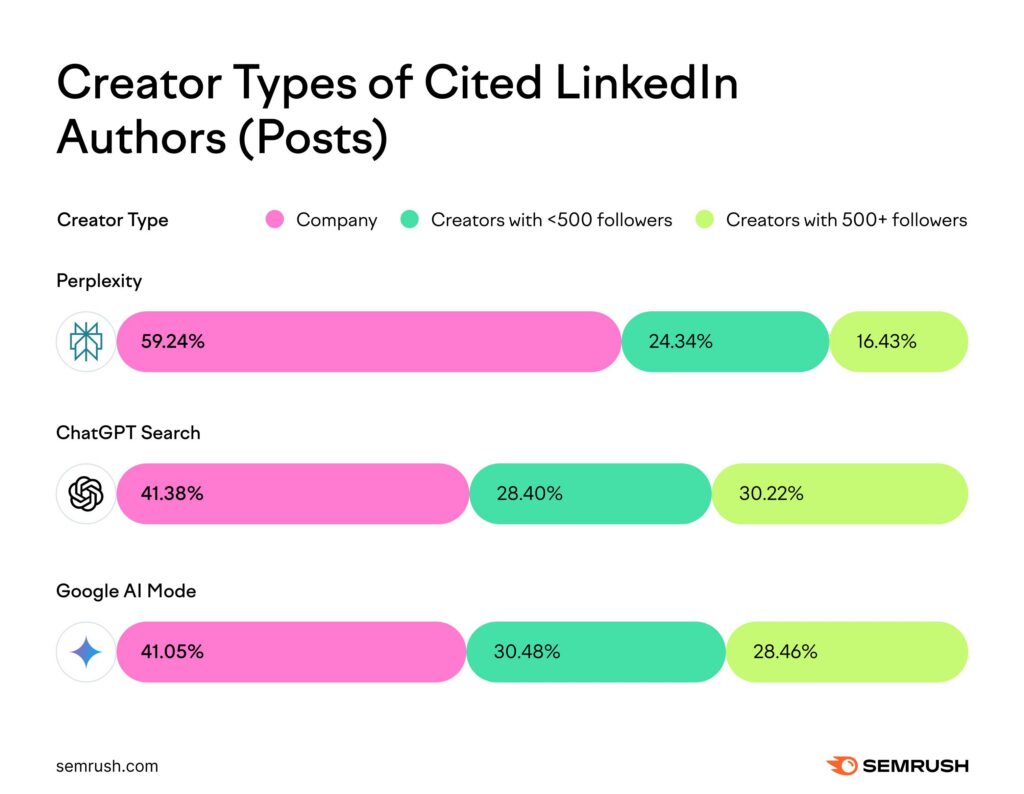
Semrush found that Perplexity sourced 59% of its LinkedIn citations from Company Pages, while ChatGPT Search and Google AI Mode sourced 59% from individual creators.
That is a significant distinction.
A strategy built entirely around executive posting may improve visibility in one environment while underweighting the role of the corporate LinkedIn presence somewhere else.
Equally, building out the Company Page while leaving recognised experts silent could limit the evidence available to AI systems that prefer individual voices.
LinkedIn has wrapped these different signals into what it calls its Credibility Stack, combining company presence, employee expertise, customer proof and creator endorsement.
The label is convenient marketing for LinkedIn, but the underlying idea is reasonably well supported by the data.
AI systems appear to value a mixture of identifiable people, organisations and substantive content rather than one single source type.
LinkedIn Is Strong In The Right Context
None of the findings make LinkedIn a universal answer to AI visibility.
Profound’s broader work across industries and AI models has repeatedly shown that citation behaviour varies significantly by sector, query type and platform. Its research across 29 industries found substantial differences in which domains different AI systems rely on, while separate analysis found that citation sources can vary heavily between models.
Funnel stage can shift the source mix again.
A general category question might pull heavily from publishers and educational sources. A product comparison could favour reviews, Reddit or specialist media. A question about a company’s leadership or professional expertise may make LinkedIn much more influential.
YouTube can dominate where demonstration matters. Reddit often performs strongly for peer opinion and lived experience. Corporate websites remain important for authoritative first-party information.
LinkedIn performs particularly well for professional and B2B queries because the platform contains exactly the kind of information those questions require: identifiable experts, employment history, company context and current industry discussion.
Treating LinkedIn’s 11% average as a benchmark for every industry would therefore miss the point.
Teams need to understand which sources actually appear around the questions relevant to their own organisation.
Social Copywriting Is Starting To Serve Two Jobs
The research also adds another consideration to social copywriting.
LinkedIn content has traditionally been optimised primarily for feed distribution. Hooks, engagement, comments and format choices influence how far a post travels within the platform.
AI discovery creates another audience for that content.
Posts need enough context for a retrieval system to understand what they are about, who is providing the information and why the material may be useful.
Generic thought leadership becomes less helpful in that environment.
Specific explanations, clear terminology, informed opinions and useful answers provide stronger material for both human readers and AI systems.
Semrush also measured relatively high semantic similarity between LinkedIn content and the AI answers that cited it, at around 0.57 to 0.60. According to Semrush, those levels were higher than comparable results it had previously recorded for Reddit and Quora.
In practical terms, useful LinkedIn content is not merely being cited as supporting evidence. Elements of its meaning can carry directly into the answer an AI system produces.
For brands, that makes the quality and clarity of what employees and company pages publish more consequential.
Social Is Becoming Part Of Search Strategy
LinkedIn’s study adds another piece of evidence to a wider shift already taking place across discovery.
Websites, social platforms, creator content, forums, professional networks and publishers increasingly feed into the same AI-generated answers.
The relative importance of each source changes by question.
For professional and B2B discovery, LinkedIn looks increasingly important. Profound identified the pattern independently, and the newer Semrush analysis provides considerably more detail about the content being cited.
The sensible response is not to start manufacturing LinkedIn posts for AI crawlers.
Marketing and communications teams should instead identify the subjects they want to be associated with, understand the questions customers are asking around those subjects and make sure credible expertise is being published consistently in the places those answers are being sourced.
For many B2B organisations, LinkedIn is clearly becoming one of those places.







RECOMMENDED FOR YOU
Google Gives Advertisers More AI Max Visibility
Google is introducing new AI Max reporting capabilities, giving…
Google is introducing new AI Max reporting capabilities, giving…
[STUDY] AI Content Production Keeps Accelerating
93% of marketers now use AI to support content…
93% of marketers now use AI to support content…
Meta Launches AI Agent For Businesses
Meta is extending its AI capabilities beyond Facebook, Instagram…
Meta is extending its AI capabilities beyond Facebook, Instagram…