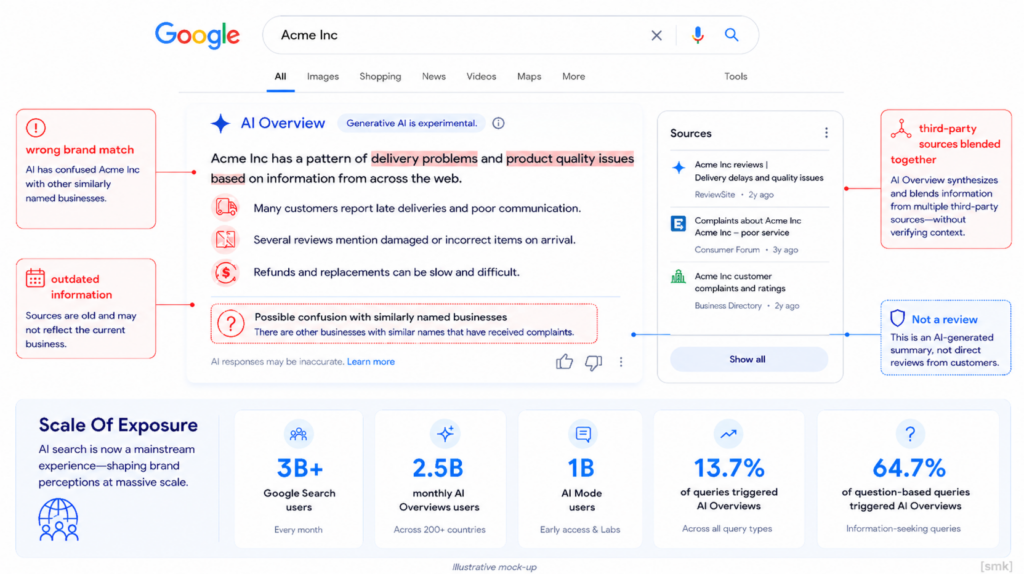
Google’s AI search products are creating a new reputation management problem for brands. Businesses are already reporting cases where AI Overviews have confused companies, surfaced unrelated complaints and presented outdated information as part of authoritative looking summaries.
At small scale, those errors could be dismissed as another generation of search oddities. Google’s reach makes that much harder.
Google Search now reaches more than 3 billion users. AI Overviews have more than 2.5 billion monthly users, while AI Mode has passed 1 billion. Neither experience appears on every query, but both are expanding quickly, with Google saying AI Mode queries have been more than doubling each quarter.
Academic research also suggests AI Overviews are already becoming particularly prominent on more complex searches. One 2026 study covering more than 55,000 Google queries found AI Overviews appeared on 13.7% of searches overall, rising to 64.7% when queries were phrased as questions.
As more search journeys are mediated through generated answers rather than conventional lists of links, mistakes about brands become more consequential. Google is no longer simply ranking information about an organisation. Increasingly, it is interpreting that information and presenting its own version back to the user.
Google Is Becoming Part Of The Brand Narrative
Business Insider recently documented several businesses affected by inaccurate AI Overviews.
UK company The Plastics Shed was described as having overwhelmingly negative customer feedback, including complaints about delayed deliveries, damaged products and dishonest staff. The reviews appeared to relate to competitors and companies selling actual plastic sheds rather than the business being searched for.
NW Select Property Management in Idaho found Google conflating it with similarly named organisations, including one that had closed years earlier. A Virginia real estate agent was still being described as servicing Tampa Bay three years after relocating.
Traditional search leaves users with several sources to assess. A company website, Google Business Profile, reviews, news coverage and community discussion can all appear alongside one another, often with obvious differences in credibility and context.
AI search compresses those signals into a single answer.
Google can draw from websites, reviews, publishers, forums, social platforms and other sources, then synthesise them before the user sees anything. When the synthesis is accurate, that can save considerable time. When it is wrong, the user may never know which part went wrong or where the underlying claim originated.
The generated answer itself becomes the brand impression.
Accurate Sources Can Still Produce The Wrong Answer
The problem is not limited to fabricated facts.
Google can retrieve legitimate information and still assemble it incorrectly.
The 2026 academic study of AI Overviews broke generated responses into 98,020 individual claims and found around 11% were not supported by the pages cited alongside them. Nearly 30% of cited domains also failed to appear on the conventional first page of Google results for the same searches.
AI visibility therefore does not simply mirror SEO rankings. Google may retrieve a different set of sources, combine them differently and produce a narrative that sits above the material underneath.
For brands, that makes reputation management harder.
An organisation can maintain an accurate website, well managed Google Business Profile and respectable search presence while still being described incorrectly because Google has pulled in old information, confused a similarly named business or given disproportionate weight to an external source.
Negative sentiment adds another dimension. BrightEdge research earlier this year found Google AI Overviews were somewhat more likely than ChatGPT to express negative sentiment about brands. Most references remained positive or neutral, and Google challenged how the difference was characterised, noting that the absolute gap was less than one percentage point.
At Google’s scale, however, even relatively small error rates or sentiment differences can translate into a substantial number of brand interactions.
The Bigger Problem Is Visibility
Marketing and communications teams are accustomed to monitoring public brand signals.
SEO teams can track rankings and search visibility. PR teams can monitor media coverage. Social teams can see mentions and comments. Customer experience teams can analyse reviews and complaints.
AI generated answers are much harder to observe.
Responses can change according to the wording of the prompt, the platform being used, timing, location and increasingly the individual user. Google is already developing more personalised AI search experiences, including optional connections with products such as Gmail and Google Photos.
Running a handful of brand searches therefore tells an organisation very little about what customers are actually seeing.
A user might ask whether a company is trustworthy, how it compares with a competitor, whether its customer service is good, what people think of its products, whether its leadership is credible or whether it has experienced a particular controversy.
Each question can trigger different sources and different conclusions.
The possible prompt universe is enormous, while the organisation itself has no direct view of all the answers being generated.
That leaves a substantial monitoring blind spot.
Third party AI visibility platforms such as Profound and Peec are beginning to close part of it. They allow organisations to track selected prompts, monitor citations and brand mentions, compare competitors and identify which sources repeatedly shape AI answers.
Their role is likely to become more important as AI discovery grows.
They still cannot tell a business exactly what every customer is seeing. Prompt combinations are effectively unlimited, outputs can vary between runs and greater personalisation will make complete visibility even less realistic.
AI reputation monitoring is therefore closer to systematic sampling than traditional analytics.
Teams can identify patterns and significant problems, but they cannot yet observe the full customer experience.
Ownership Is Still Unclear
Limited visibility creates another problem inside organisations: who is actually responsible for it?
The answer is not obvious.
SEO teams understand search visibility and source authority, but they may not own corporate reputation. PR and communications teams own reputation, messaging and issues management, but may have limited experience with AI search monitoring. Digital teams may control analytics and search tooling without owning the external information influencing an answer.
Agency structures can make the boundary even less clear. A brand may have separate SEO, PR, media, social and digital agencies, none of which has a mandate to monitor how AI systems synthesise information across all of those areas.
In many organisations, nobody currently owns the whole problem.
Yet fixing an inaccurate AI answer can require contributions from several teams.
First-party website information may need updating. Structured data may need attention. An old publisher article might require correction. A misleading review could need a response. Confusion around company names may require stronger entity signals. Authoritative external coverage may need to be strengthened.
The eventual AI answer sits downstream from all of them.
AI reputation management therefore looks less like a completely new communications discipline and more like a coordination problem spanning search, PR, content, digital and customer experience.
Someone still needs to own it.
The Sources Around A Brand Matter More
Google continues to recommend familiar search fundamentals for AI visibility: accurate Business Profiles, accessible websites, strong content and structured data that matches what users can see on the page.
Those foundations remain important, but brands only control part of the information environment from which AI systems learn.
Publishers, reviews, social platforms, communities and professional networks increasingly help shape the answer.
The source mix also changes substantially according to industry, query type and funnel stage.
LinkedIn can carry considerable weight for professional and B2B questions. Reddit often surfaces around experiences, opinions and comparisons. YouTube can become important where demonstrations or reviews influence the decision. Specialist publishers may dominate technical or high-consideration categories.
A company therefore needs to understand not only how it presents itself, but where AI platforms look when users ask important questions about it.
That requires a broader view of digital reputation than ranking the corporate website.
Fixing The Answer Can Be Difficult
Incorrect information on a company website can be corrected directly.
An incorrect AI interpretation may not exist verbatim anywhere.
Businesses interviewed by Business Insider described repeatedly reporting inaccurate responses to Google. Some saw improvements, although incorrect information could later reappear.
That instability is part of the difficulty. A brand may check an AI Overview, find it accurate and assume the problem is solved, while a different query or future generation produces something else.
Legal responsibility is also starting to be tested.
A Munich court ruled in June that Google could be held responsible for false statements contained in AI Overviews after two German publishers argued that generated summaries wrongly associated them with scams and questionable business activity. Google is appealing the decision.
The case gets to the heart of the issue. Google is not merely displaying somebody else’s statement. Its AI systems are selecting sources, combining information and producing a new response.
The more prominent those responses become, the harder it will be to separate search visibility from reputation management.
AI Reputation Needs An Owner
Most organisations are only beginning to track whether they appear in ChatGPT, Gemini, Perplexity or Google AI results.
Presence is only part of the picture.
A brand can be highly visible and badly represented.
Monitoring therefore needs to consider accuracy, sentiment, source quality and consistency across the questions that matter commercially and reputationally.
Google’s scale makes that increasingly difficult to ignore. AI Overviews already reach billions of users and AI Mode is growing quickly. As generated search becomes a larger part of mainstream discovery, the number of AI mediated brand impressions will grow with it.
Marketing and communications teams will not have perfect visibility into those interactions. Third party monitoring can narrow the gap, but a sizeable blind spot remains.
The more immediate organisational question is simpler.
Who is responsible for watching what AI says about the brand, deciding when something is wrong and coordinating the work required to change it?
For plenty of organisations today, the answer is probably nobody.















RECOMMENDED FOR YOU
Google Gives Advertisers More AI Max Visibility
Google is introducing new AI Max reporting capabilities, giving…
Google is introducing new AI Max reporting capabilities, giving…
[STUDY] AI Content Production Keeps Accelerating
93% of marketers now use AI to support content…
93% of marketers now use AI to support content…
Meta Launches AI Agent For Businesses
Meta is extending its AI capabilities beyond Facebook, Instagram…
Meta is extending its AI capabilities beyond Facebook, Instagram…