
Meta believes the future of online discovery looks less like traditional search and far more like algorithmic feeds, creators and AI-powered recommendations.
In a new report and accompanying blog series, the company outlined how consumer behaviour is shifting away from conventional Google searches and towards social-first discovery experiences driven by short-form video, creators and personalised recommendations.
One statistic stood out in particular. According to Meta, Google searches per US user are down nearly 20% year-on-year as discovery behaviour fragments across social platforms, feeds and AI-driven experiences.
Meta’s framing is unsurprising given its commercial interests, but the broader shift it describes is increasingly difficult to ignore.
The way consumers discover products online is changing rapidly, and that change may have significant implications for content strategy, search visibility and digital advertising.
Discovery Is Becoming Embedded Into Entertainment
For years, digital discovery largely revolved around intent.
Users searched for something specific, evaluated a list of results and clicked through to websites for information. That behaviour still exists, particularly for high-intent research queries, but social platforms are increasingly influencing earlier stages of the purchase journey.
Meta argues consumers no longer think in channels. Instead, they move fluidly between different discovery environments depending on context and behaviour.
That distinction matters because social discovery functions very differently from traditional search.
On platforms like Instagram, Facebook and TikTok, discovery is increasingly passive. Users are not always actively searching for products. Instead, products surface naturally within entertainment content, creator recommendations and algorithmic feeds.
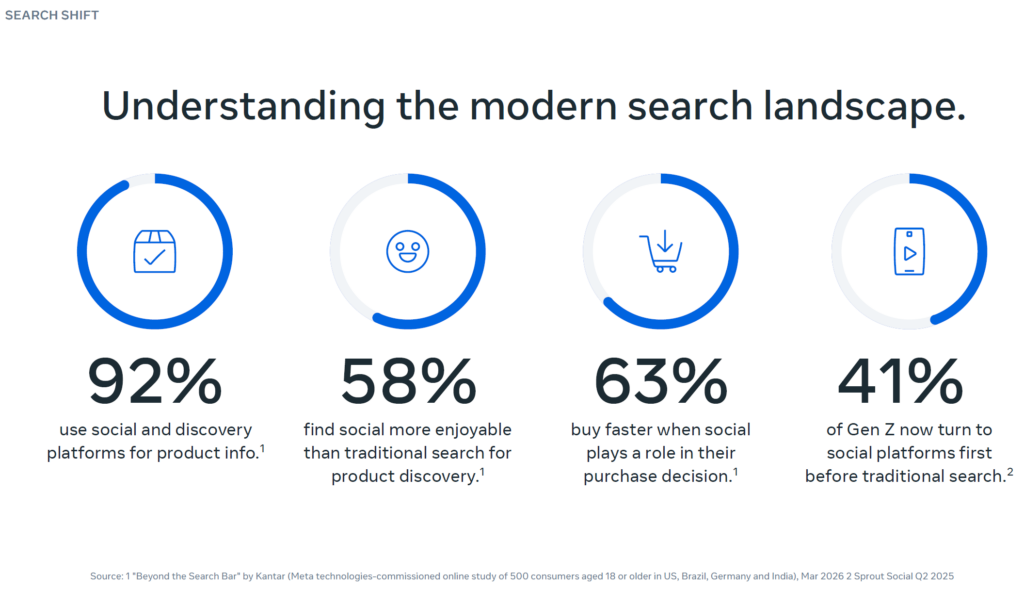
Meta’s research suggests 92% of consumers now use social and discovery platforms for product information, while 58% say social discovery is more enjoyable than traditional search.
In many cases, users encounter products before they consciously begin researching them.
That changes the role content plays in marketing. Rather than simply responding to demand, social platforms are increasingly shaping demand itself.
Short-Form Video Is Becoming The Discovery Layer
A major driver behind the shift is the continued rise of short-form video.
Meta’s report repeatedly highlights video content as central to modern discovery behaviour, particularly as social platforms evolve into entertainment ecosystems rather than purely social networks.
According to the study, 61% of consideration actions now happen through short videos and Reels, making them the most influential format during the discovery process.
The influence of creators is also becoming more commercially important. Meta found that 43% of users are influenced by creator demos, reviews and recommendations, while 41% are influenced by user-generated content and customer reviews.
That reflects a broader shift in how trust is built online.
Traditional search has historically prioritised relevance and authority signals. Social discovery operates far more through visual proof, peer validation and creator influence.
Meta’s own data suggests 65% of consumers feel more confident in purchases when social platforms play a role in the buying process, while 63% say purchases happen faster when social influences are involved.
For marketers, discoverability increasingly depends on whether content feels culturally relevant, visually engaging and native to the platform environment itself.
AI Could Accelerate The Shift Further
Meta also sees AI becoming central to the next phase of discovery.
Because Meta platforms combine behavioural data, engagement signals, creator content and product interactions within one ecosystem, the company believes it is well positioned to power AI-driven recommendations at scale.
That could fundamentally change how online discovery works.
Instead of users actively searching for products, platforms increasingly predict what users may want before explicit intent is expressed.
Discovery becomes recommendation-led rather than search-led.
Meta’s report suggests that shift is already underway. According to its research, 49% of consumers already use AI assistants for product discovery, while 70% expect to increase AI-assisted shopping usage over the next six months.
The company also tied this directly to its broader commerce ambitions, positioning product catalogues as increasingly important discovery assets inside AI-powered experiences like Meta AI and Muse Spark.
That creates new competitive pressure for Google.
Traditional search still dominates high-intent informational queries, but social platforms increasingly control the moments where inspiration, awareness and consideration happen. AI recommendations may strengthen that further by making discovery more personalised and continuous.
Search Budgets Are Starting To Fragment
Meta’s report also points towards broader changes in advertising investment.
Citing eMarketer data, the company notes that advertisers are expected to spend more than $100 billion on non-Google search ads by 2028, while Google’s share of US search ad spend is projected to fall below 50% in 2026, down from 67.1% a decade ago.
That does not mean Google becomes irrelevant. However, it does suggest marketers are increasingly diversifying discovery investment across social, retail media, AI platforms and creator ecosystems.
Meta also claims its own platforms are becoming more effective at driving incremental customer acquisition. According to research cited in the report, 64% of Meta’s incremental conversions are new-to-brand customers, while Meta campaigns generated 2.3x higher incremental return on ad spend compared with search for new customer acquisition.
Again, those figures come from Meta-backed analysis, but they reinforce the company’s broader argument that discovery itself is becoming more distributed.
Discovery Is Becoming Predictive
Perhaps the most important takeaway from Meta’s report is not that social platforms are replacing search, but that discovery itself is becoming more predictive and algorithmic.
Meta describes traditional search as “utility” and social search as “influence”.
That distinction feels increasingly accurate.
Search is no longer simply about retrieving information after intent exists. Platforms are increasingly shaping, influencing and accelerating intent before users actively search at all.
For marketers, that means discoverability can no longer be approached purely through SEO rankings or paid search visibility alone.
Content now needs to work across recommendation systems, creator ecosystems, social feeds and AI-assisted environments simultaneously.
Meta’s report ultimately reflects a broader industry reality. Discovery is becoming less about users actively searching for information and more about platforms predicting, surfacing and shaping what users see next.

























RECOMMENDED FOR YOU
[STUDY] ChatGPT Powers Work And Life
OpenAI, in collaboration with Harvard economist David Deming, has…
OpenAI, in collaboration with Harvard economist David Deming, has…
LinkedIn Tests New Premium Tools for SMBs
LinkedIn is quietly piloting a new Premium offering designed…
LinkedIn is quietly piloting a new Premium offering designed…
Meta Brings AI Video Editing to Instagram and Meta AI
Meta has launched a new AI-powered video editing feature…
Meta has launched a new AI-powered video editing feature…