
Microsoft is bringing brand systems directly into Copilot’s production workflow.
Its latest release expands Copilot’s access to approved brand assets, organisational templates and governed business data across PowerPoint, Excel and the wider Microsoft 365 environment. Word, Excel and PowerPoint agents can also be called directly from Copilot Chat to create documents, spreadsheets and presentations.
Taken individually, many of the additions may look incremental. Together, they move Copilot closer to producing work that is not only generated quickly, but also shaped by an organisation’s own visual standards, data and review processes.
Marketing teams have spent several years testing AI for drafting, ideation and analysis. The harder task often begins after the first output appears.
Presentations still need to follow brand rules. Reports need approved figures. Documents need the correct structure. Stakeholder materials need review, comments and sign-off.
Microsoft is starting to connect more of those requirements inside the same production environment.
Brand Systems Are Entering The Workflow
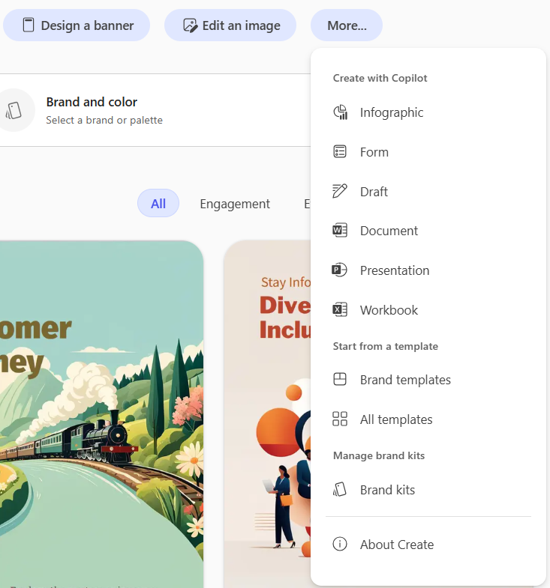
The latest Copilot release connects more deeply with Microsoft’s Brand Center, a central library where organisations can manage approved logos, colours, fonts, imagery, templates and brand guidelines.
Brand managers can create official brand kits and make them available across Microsoft 365. Copilot can then use those approved assets when generating presentations, reports, posters and other materials, rather than relying on generic designs or whatever files an individual user happens to upload.
PowerPoint can draw on organisational templates, sample slides and approved brand assets when creating or editing a presentation. Microsoft’s Brand Reviewer can also flag problems involving colours, fonts, logos, imagery, layout and spacing, then suggest corrections.
Excel is gaining similar capabilities, with a brand kit skill that can apply approved colours, fonts and logos to tables and charts. A theme design skill is intended to turn raw analysis into a more polished report with clearer hierarchy and presentation.
AI can already produce a competent first draft quickly. Turning that draft into something that looks, sounds and feels as though it belongs to the organisation usually takes considerably longer.
Bringing brand systems into the workflow could reduce some of that manual production work. The results will still depend heavily on how well those systems are maintained.
Templates need to be properly structured, assets need to be current and brand guidance needs to be clear enough for Copilot to interpret. A folder containing six old logos and three contradictory PowerPoint templates is not much of a brand system, regardless of how much AI is attached to it.
Office Agents Connect The Production Process
Copilot users can now call Word, Excel and PowerPoint agents from within the main chat interface.
A marketer could begin with a request to develop a campaign performance update, invoke Excel to analyse the figures, bring in PowerPoint to create the stakeholder presentation and use Word to prepare the accompanying briefing.
The applications remain distinct, but Copilot becomes a more consistent starting point for moving between them.
Microsoft has been moving towards connected, multi-stage work for some time. The latest release makes that direction more visible inside the everyday Office environment.
Creating a document from chat is not especially remarkable on its own. The more useful development is Copilot’s growing ability to carry organisational context into the resulting output.
OpenAI and Anthropic models are also becoming available across more of the Copilot environment. Model choice will attract attention, but it is not the most important part of the release for most marketing teams.
A more capable model is useful. A model connected to the right information, applications, templates and production standards is considerably more useful.
Governed Data Moves Closer To The Deliverable
Copilot in Excel can now ground analysis in governed Power BI data.
Users can attach a Power BI report, ask Copilot to identify trends, analyse performance and build supporting calculations without exporting the data into a separate workbook. Microsoft says existing row-level security continues to apply.
The development is particularly relevant to campaign reporting and executive communication.
Marketing teams routinely move figures between analytics platforms, spreadsheets, slide decks and written summaries. Every transfer creates opportunities for inconsistent definitions, outdated numbers and manual errors.
Copilot’s connection to Power BI does not solve the underlying measurement problem, but it may reduce some of the unnecessary movement between systems.
A marketer could, in principle, ask Excel to analyse governed performance data, apply the organisation’s approved visual standards and prepare a presentation-ready report using recognised metrics.
“Governed” remains the important word.
Copilot cannot resolve disagreement over how a lead is defined, which revenue figure should be used or whether an attribution model is credible. It can only work with the data and definitions the organisation has already established.
More polished reporting may make poor measurement look more authoritative. Marketing leaders still need to understand what sits beneath the finished chart.
Review Is Becoming Part Of AI Production
Microsoft is also pushing Copilot further into review and editing.
Word can now work within tracked changes, allowing proposed revisions to remain visible for human approval. Copilot can add, read, reply to and manage comments, while also supporting more of the document structure through headers, footers, page numbers and tables of contents.
PowerPoint is gaining similar support for comments and review processes. SharePoint can generate Office files using natural language and create approval tracking within lists and libraries, while reusable skills can encode repeated instructions around layouts, branding and process.
AI-assisted content has often sat awkwardly outside formal production workflows. Someone generates a draft, copies it into the correct template and then passes it into the same review process used before the AI appeared.
Copilot is moving closer to the review layer itself.
The distinction matters because most organisational content is not approved at the point of creation. Campaign plans, executive presentations, stakeholder briefings and performance reports usually pass through several rounds of comment, correction and sign-off.
Marketing productivity will not improve much if AI accelerates drafting while review remains fragmented across email, Teams, documents and informal conversations.
Production Quality Depends On Organisational Readiness
Microsoft’s latest release makes Copilot more relevant to marketing production, but it also raises the standard required for successful implementation.
Brand assets need to be current and centrally managed. Templates need enough structure for Copilot to interpret them. Power BI metrics need agreed definitions. SharePoint permissions need to reflect who should access, edit and approve particular information.
Teams also need to decide which stages of production can be delegated and where human judgement remains essential.
A presentation can be visually compliant while making a weak argument. A branded report can still contain misleading analysis. A polished campaign brief can still reflect the wrong audience assumptions.
Copilot is becoming better at assembling organisational inputs into finished-looking work. Finished-looking and finished are not the same thing.
Marketing teams should test the new capabilities against real production tasks rather than generic demonstrations.
A useful pilot might involve one recurring deliverable, such as a monthly campaign report, an executive presentation or a stakeholder briefing.
The test should examine how much manual assembly is removed, whether the correct data and assets are used, where human intervention remains necessary and whether the final output genuinely meets the organisation’s standard.
Prompting Is Becoming A Smaller Part Of The Job
Prompt quality still matters, but it is becoming only one component of workplace AI performance.
The value of Copilot will increasingly depend on the quality of the wider production environment surrounding it: the data it can access, the templates it can interpret, the brand rules it can apply and the review processes it can enter.
Marketing teams that treat Copilot as a writing assistant will use only a fraction of its growing capability.
Teams that treat it as a production layer face a larger implementation task. They also have a better chance of reducing the repetitive assembly work that sits between an idea and a credible organisational deliverable.
Microsoft is not removing the need for marketing operations, brand management or human review. It is making those systems more visible as the foundations on which useful AI production depends.

























RECOMMENDED FOR YOU
Google Gives Advertisers More AI Max Visibility
Google is introducing new AI Max reporting capabilities, giving…
Google is introducing new AI Max reporting capabilities, giving…
[STUDY] AI Content Production Keeps Accelerating
93% of marketers now use AI to support content…
93% of marketers now use AI to support content…
Meta Launches AI Agent For Businesses
Meta is extending its AI capabilities beyond Facebook, Instagram…
Meta is extending its AI capabilities beyond Facebook, Instagram…