
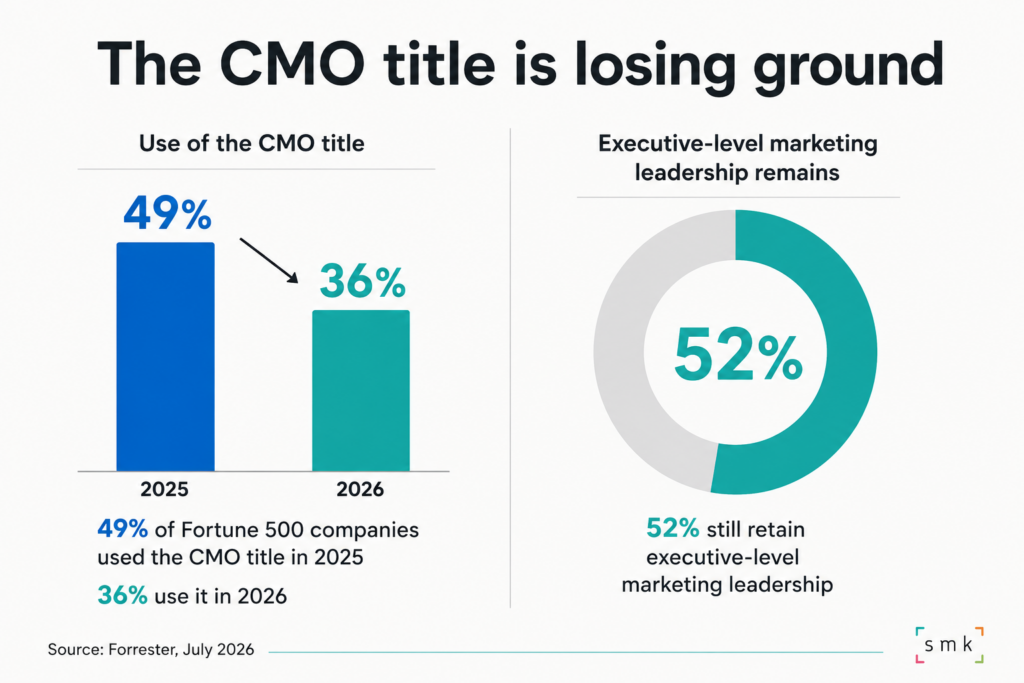
The chief marketing officer title is disappearing from many of the world’s largest companies.
Only 36% of Fortune 500 businesses now use the CMO title, down from 49% in 2025, according to Forrester’s latest analysis of senior marketing leadership. Executive-level marketing representation has also fallen, with senior marketing leaders sitting on the executive team or reporting to the CEO at 52% of Fortune 500 companies, down from 58% a year earlier.
The figures initially look like another difficult chapter in the long-running debate over marketing’s influence.
Yet marketing leadership is not simply being removed. In many companies, it is being reorganised under broader titles such as chief growth officer, chief commercial officer and chief customer officer.
The CMO name may be losing ground because the job itself is being stretched across a much larger commercial remit.
The CMO Title Is Losing Ground Quickly
Forrester’s third annual Fortune 500 analysis shows a clear decline in both the title and the executive visibility of marketing leadership.
Almost one quarter of Fortune 500 companies changed their senior marketing leader during the past year. Average tenure remained unchanged at 3.9 years, suggesting that companies are frequently redesigning the role but still giving appointees several years to prove themselves once in place.
Variation between industries also remains substantial. CMO representation in energy and mining was less than half the level recorded across financial services, while tenure differed by more than 20% across B2B, B2C and mixed business models.
Such differences make a universal obituary for the CMO difficult to sustain.
The wider direction is still hard to ignore. Boards and chief executives appear less convinced that brand, communications, demand generation and customer engagement should sit under a standalone marketing title.
Many companies are instead trying to connect those functions more directly with sales, customer experience, revenue and growth.
That can be read as an expansion of marketing’s influence. It can also be read as a transfer of power away from marketing.
Marketing Is Being Folded Into Growth
The rise of chief growth, commercial and customer roles reflects growing frustration with organisational silos.
A conventional CMO may oversee brand, advertising, communications, customer insight and demand generation. A chief growth officer can be given responsibility across marketing, sales, customer success, pricing, product or international expansion.
The broader structure promises clearer accountability for commercial outcomes across the full customer lifecycle.
It also changes the test applied to marketing leadership.
Senior marketers are increasingly expected to connect brand investment with demand, sales conversion, customer experience, retention and revenue. Campaign delivery remains part of the remit, but it is no longer enough to justify a permanent position at the top table.
According to figures Lippincott shared with Business Insider, 35% of marketing chiefs now come from performance or growth marketing backgrounds. Around 20% of the most senior marketing decision-makers do not have the word “marketing” in their title, reflecting the rise of chief growth, chief revenue and chief commercial officers.
The direction suits leaders who are comfortable moving between brand and commercial performance. It is less forgiving for marketing functions still organised mainly around channels, campaigns and communications outputs.
A broader title can give a marketing leader more scope to influence the business. It can equally give another executive permission to absorb marketing into a wider commercial operation.
More Responsibility Does Not Guarantee More Power
A larger remit sounds like progress until the authority behind it is examined.
Lippincott and Bloomberg Media surveyed 541 global CMOs and equivalent senior marketing leaders. Nearly eight in ten said bureaucracy regularly interfered with decision-making, while 84% reported difficulty aligning senior stakeholders around a marketing vision. Only 44% believed marketing operated with a high degree of autonomy.
Marketing leaders may therefore be gaining responsibility for growth without gaining the control needed to deliver it.
Customer experience may sit elsewhere. Sales may be managed independently. Product teams may set priorities without marketing input. Technology, data and budget decisions may remain under finance or IT.
The title can broaden while the operating model stays fragmented.
A chief growth officer held accountable for acquisition, retention and customer value will struggle when the underlying decisions remain dispersed across several executive functions. A CMO cannot integrate the customer lifecycle by PowerPoint alone.
Broader titles may partly represent an attempt to connect marketing more closely with revenue and commercial accountability. Renaming the role does not automatically solve weak measurement, poor cross-functional alignment or limited decision-making authority.
Short-Term Pressure Can Narrow The Mandate
Lippincott’s research found that CMOs ranked long-term sustainable growth among their highest priorities. Their day-to-day effort was nevertheless dominated by short-term targets and proving attributable impact.
The tension becomes more pronounced as performance data and AI systems make activity easier to track.
Greater visibility can help marketing build credibility with finance and executive leadership. It can also encourage organisations to reward whatever produces the fastest measurable result.
Clicks, leads, conversions and quarterly pipeline become easier to defend than brand strength, cultural relevance, future demand or customer trust.
Lippincott also found that companies were increasing investment in AI while reducing investment in areas including websites and content, despite those assets helping AI systems understand and surface brands.
A growth-led marketing role can therefore become narrower rather than broader when growth is defined mainly through short-term performance.
Marketing leaders may gain responsibility for more outcomes while losing the time, budget and organisational patience needed to shape them.
The CMO Role Is Becoming An Organisational Design Test
Forrester describes the current movement as reinvention rather than straightforward decline. Large companies are experimenting with how marketing, sales, customer engagement and commercial accountability should be organised.
Some traditional CMO roles will disappear during that process.
Others will evolve into larger positions with authority across growth, customer experience, sales or commercial strategy.
The decline of the title does not necessarily mean marketing matters less. In many companies, the opposite may be true. Brand, demand, experience, retention and growth are becoming harder to separate, forcing organisations to reconsider where marketing leadership sits and how much authority it carries.
A broader title can create a larger role. It can also disguise a weaker one.
Chief growth, customer or commercial officers will struggle if responsibility expands while control over budget, data, product, sales and customer experience remains fragmented. Changing the title without changing the operating model merely gives the same organisational problem a newer name.
Marketing leaders face a similar choice.
Those who remain defined mainly by campaigns, channels and communications risk being pushed further from commercial decision-making. Those who can connect customer insight, brand, demand, experience, sales and retention have an opportunity to shape a much wider growth agenda.
The strongest CMOs may not preserve the title. They may outgrow it.
A marketing leader who helps determine how the organisation competes, earns trust and grows becomes much harder to remove. They may even end up with a bigger chair at the top table, regardless of what appears on the door.