
Meta is using large language models to understand content more deeply across Instagram and Facebook, reshaping how posts are classified, recommended and distributed.
Every public Feed and Reels post on Instagram is now processed through an LLM and assessed across factors including its topic, tone and likely audience relevance. Meta is also using its Muse models to classify and summarise video content, with similar systems gradually being extended across Facebook.
The changes appear to be increasing consumption. Meta says time spent on Instagram grew by double digits year on year during the second quarter, driven largely by improvements to Feed and Reels recommendations. According to Meta CFO Susan Li, Facebook video time also rose 9% globally and by more than 10% across the US and Canada, where ranking improvements helped drive the increase.
For brands and creators, the development pushes social distribution further away from a model built primarily around followers.
Meta’s systems are becoming better at interpreting what a piece of content is about, identifying who may find it useful and recommending it beyond the audience already connected to the account.
Organic reach is not suddenly becoming easy again. Distribution is becoming more open to content that gives Meta’s systems a strong reason to recommend it.
Meta Is Learning What Content Means
Social recommendation has traditionally relied heavily on behavioural signals such as watch time, saves, shares, comments, follows and previous interactions.
Those signals remain important, but Meta says LLMs now provide a more direct understanding of what content contains, why it may be compelling and which users may be most likely to respond.
A video about workplace change, for example, can be classified by subject, tone and likely audience relevance soon after publication. Distribution no longer needs to depend entirely on an existing follower base or a large burst of early engagement.
Meta also says its upgraded infrastructure can identify promising new Reels at the point of creation. More than half of recommended content in Instagram Feed is now less than a day old, more than double the proportion recorded a year earlier.
Freshness is therefore becoming more influential. Strong content may gain exposure quickly, but its useful life may also shorten as Meta continually introduces newer alternatives.
Marketing teams may need to rely less on occasional hero posts and place more emphasis on a steady flow of timely, clearly differentiated material.
Reach Is Moving Further Beyond Followers
Meta’s feeds have been shifting towards interest-based recommendations for several years. The latest systems deepen that transition by improving the platform’s ability to match individual posts with people who have no previous relationship with the publisher.
Instagram’s largest single Reels ranking update to date produced a 15-basis-point increase in sessions, with Meta reporting particular gains in reshares and time spent. A similar system is now being introduced into Feed.
The opportunity is useful for organisations whose social audiences have stalled or whose follower growth no longer translates reliably into reach.
A strong post can travel beyond the organisation’s established community. Smaller accounts can compete for attention alongside larger publishers when their content performs well against the interests and behaviours Meta is trying to satisfy.
However, Meta has not announced a general increase in brand reach, nor has it suggested that commercial accounts should expect more free distribution.
Engagement growth across the platform does not tell us how much additional exposure is flowing to brands, publishers, creators or AI-generated content. Meta’s commercial incentive remains unchanged. Better recommendations keep people inside its apps for longer, creating more opportunities to serve advertising.
Family of Apps advertising revenue rose 27% year on year to US$59.4 billion during the quarter, while total ad impressions increased 14%.
Greater content discovery and greater advertising inventory can comfortably coexist.
Clear Subject Matter Becomes More Valuable
LLM-based analysis raises the value of content that is easy to understand without becoming simplistic.
Social optimisation has often centred on engagement mechanics: stronger hooks, faster edits, captions, trending audio and prompts for comments. Those techniques still matter, but Meta’s systems are also examining what the content actually says.
Clear themes, recognisable expertise and consistent subject matter give the recommendation engine more information to work with.
An account that moves between disconnected corporate updates, generic observance-day posts and occasional campaign material may be harder to match with a coherent audience. An organisation that repeatedly addresses a defined set of customer problems gives Meta a clearer pattern.
Clarity should not be confused with keyword stuffing. Social content still needs to hold attention and prompt a meaningful response. Labelling every subject in mechanical terms will not rescue unremarkable material.
Meta’s systems are combining semantic understanding with user histories and behavioural data. Content needs to make sense to the machine, but it still succeeds or fails with people.
Original Content Retains An Advantage
Meta has also been increasing the proportion of original material appearing in recommendations.
By the end of 2025, 75% of Instagram recommendations in the US came from original posts. Meta increased the prevalence of original content by ten percentage points during the final quarter of the year. On Facebook, ranking improvements produced a 7% lift in views of organic Feed and video posts during the same period.
Combined with LLM-based content analysis, the trend strengthens the case for producing material rooted in an organisation’s own knowledge, evidence and experience.
Repackaging a common industry observation into another short video may satisfy the format requirements without giving the recommendation system much reason to prioritise it. Distinctive information, informed opinion, useful demonstrations and credible access to people or events are harder to substitute.
AI will make competent content easier to produce. Meta is improving its ability to assess and rank that expanding supply at the same time.
More production alone is unlikely to create a lasting reach advantage.
Users Are Gaining More Control Over Their Feeds
Meta is also allowing users to influence recommendations more directly.
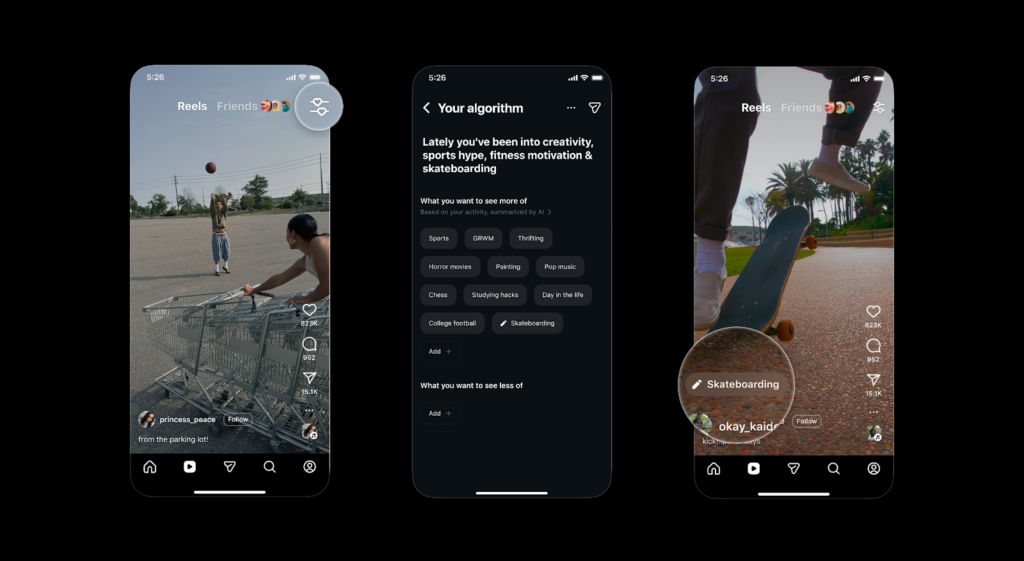
Instagram’s Your Algo page lets people use natural-language prompts to adjust what they see. Facebook has introduced a similar Shape Your Feed feature, with Meta reporting retention above 80% among people who use it.
User-directed feeds may make audience interests more explicit and change how quickly recommendation systems respond to emerging preferences.
People could become less tolerant of content that appears simply because it once performed well with a broad demographic. They can increasingly tell the platform what they want more or less of, narrowing the distance between stated interest and feed composition.
Brands will therefore be competing inside a more actively personalised environment. Broad relevance may become less valuable than strong relevance to a particular interest, need or moment.
Organic Strategy Needs A Wider Definition
Follower growth still matters. An established audience provides repeat exposure, social proof and a base of people more likely to interact with future posts.
Followers are becoming one input among several rather than the main boundary of distribution. Organic strategy now needs to consider how content will be understood, who it may be recommended to and which signals indicate that the match was successful.
Social copywriting is changing as part of that shift. Captions, on-screen text and spoken language can all give recommendation systems clearer context about what a post covers and which interests it may serve.
Elements of search optimisation are therefore moving into social content, although not in the traditional sense of inserting keywords wherever they fit. Clear language, direct descriptions and consistent subject coverage can support discovery when they accurately reflect the content.
Teams should pay closer attention to which subjects generate reach beyond existing followers, how quickly new posts receive non-follower distribution and which formats repeatedly establish a recognisable area of authority.
Meta’s reporting tools still provide only a partial view of how LLM interpretation affects individual posts. Much of the recommendation system remains opaque, and teams should resist turning earnings commentary into another round of supposed algorithm hacks.
A better response is to test how creative quality, clear copy, original expertise and consistent subject coverage work together to extend distribution beyond the existing follower base.
Meta’s AI feeds are creating more routes into organic discovery. They are not restoring the generous reach of early social media.
Organic visibility will increasingly depend on content that people value and recommendation systems can confidently understand.





















RECOMMENDED FOR YOU
[STUDY] CMOs Demand More From Agency AI
Marketing leaders are raising their expectations of agencies as…
Marketing leaders are raising their expectations of agencies as…
Google Gives Advertisers More AI Max Visibility
Google is introducing new AI Max reporting capabilities, giving…
Google is introducing new AI Max reporting capabilities, giving…
[STUDY] AI Content Production Keeps Accelerating
93% of marketers now use AI to support content…
93% of marketers now use AI to support content…