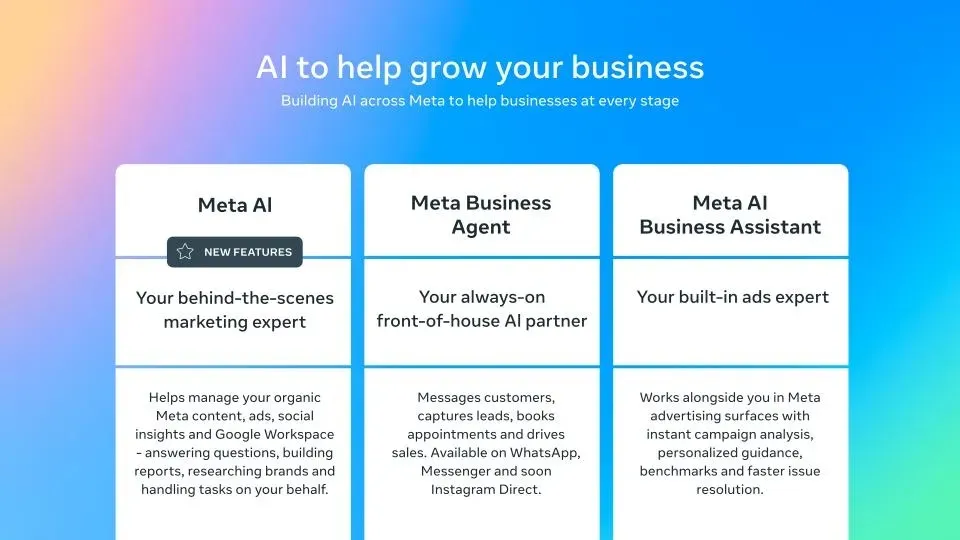
Meta is trying to move Meta AI from the sidelines of the AI market into the middle of everyday marketing work.
New capabilities can connect Meta AI directly with professional Facebook and Instagram accounts, Meta advertising campaigns and Google Workspace. Businesses can analyse organic performance, review advertising results, benchmark themselves against similar brands, create reports and presentations, and schedule recurring tasks such as weekly performance updates.
On paper, that gives Meta AI a much more practical role than it has had until now. Rather than competing mainly as a general-purpose assistant, it can start to sit closer to the systems marketers already use to plan, analyse and report on activity across Meta.
Meta is pitching the new capabilities primarily at smaller businesses, although the strategic ambition is broader. Facebook, Instagram and Meta Ads already generate a huge amount of marketing data. Bringing that data into a conversational AI layer potentially gives Meta AI a more distinctive reason to exist.
Whether marketers actually choose to use it is another question.
Meta AI has hardly set the world on fire since launch, while ChatGPT has built far stronger general adoption and Claude and Copilot are also becoming established in workplace workflows. The challenge for Meta is therefore not simply adding more capability.
It is persuading marketers that Meta AI should become one of the places where the work itself gets done.
Meta Has Already Opened Ads Manager To Other AI Assistants
That challenge is partly of Meta’s own making.
In April, Meta launched its official Ads MCP server in open beta.
MCP, or Model Context Protocol, allows AI assistants to connect directly with external systems and perform tasks through them. Meta’s implementation means compatible assistants such as ChatGPT and Claude can connect to a Meta advertising account rather than simply offering general advice about paid social.
Through that connection, an assistant can retrieve reporting, work with campaigns, ad sets and ads, manage catalogues, inspect signal quality and make changes inside the account.
For marketers already using ChatGPT or Claude every day, that creates a credible alternative to adopting another AI assistant.
Rather than learning a new interface, they can potentially bring Meta advertising into the AI environment they already use for research, planning, writing, analysis and internal work.
Meta’s latest AI release now creates some overlap between those options.
Meta AI Has More Native Meta Context
Meta AI does, however, have one important advantage.
It sits much closer to Meta’s own ecosystem.
Businesses can ask questions about Facebook and Instagram performance using signals such as reach, saves, shares, comments and profile visits. Meta AI can identify stronger content, compare activity over time and analyse publicly available content from comparable brands.
Advertising data can sit alongside that organic information.
Meta says its AI can analyse which audiences are producing results, identify patterns among stronger creative, spot creative fatigue and suggest where budgets may work harder.
Google Workspace connections add another layer. Marketing data can be combined with information from Gmail, Docs, Sheets and Slides, then turned into reports, presentations and other working documents.
Recurring tasks also move Meta AI beyond one-off analysis. A marketer could, for example, ask it to review Instagram performance and produce an updated report every Monday.
Taken together, Meta AI currently has a broader native view of Meta marketing than the Ads MCP alone gives ChatGPT or Claude.
That advantage should not be overstated.
Meta’s Ads MCP has explicit read and write capabilities, meaning external assistants can make changes inside advertising accounts. Meta’s published examples for Meta AI currently lean more heavily towards analysis, recommendations and reporting.
In practical terms, Meta AI appears broader across the Meta environment, while external assistants can already go deeper into direct advertising execution.
The gap between those two propositions is unlikely to remain static for long.
Hootsuite Broadens The External Option
Organic social also weakens the idea that Meta AI has a unique position.
Hootsuite has introduced MCP servers that bring its capabilities directly into AI assistants including ChatGPT, Claude, Copilot and Gemini.
Its Perch connector covers content creation, planning, publishing and performance. Lumen adds listening, sentiment and competitive intelligence. Nest extends into social inbox and customer care workflows.
For teams managing multiple platforms, that may be more useful than a Meta-specific AI layer.
A marketer using ChatGPT as their main AI workspace could potentially connect Meta Ads directly through Meta’s MCP, then use Hootsuite for organic publishing, performance, listening and community management.
The result starts to look less like a choice between Meta AI and ChatGPT, and more like a choice between different ways of assembling the marketing AI stack.
The Preferred Assistant May Matter More Than The Platform
That is where the competitive question becomes more interesting.
Meta controls valuable first-party data across Facebook, Instagram and Meta Ads. OpenAI, Anthropic and Microsoft do not.
However, ChatGPT, Claude and Copilot may have an equally important advantage if they become the AI environments employees already use across the rest of their work.
An organisation may reasonably decide that it does not want a different AI assistant for every major software platform.
If ChatGPT is already being used for research, planning, content development and analysis, connecting Meta Ads and Hootsuite into that environment could feel more natural than moving into Meta AI.
Another organisation may prefer Claude. A Microsoft-heavy organisation may try to pull the same activity into Copilot.
Meta AI therefore has a potentially strong data position, but a much less certain distribution position inside professional workflows.
Platform Advice Still Needs Scrutiny
There is another reason organisations may prefer some separation between the marketing platform and the AI interpreting its performance.
Meta sells the advertising that Meta AI is being asked to analyse.
A recommendation to increase spend, broaden targeting or adopt more automated campaign settings may be entirely sensible. It is still advice being generated inside the platform that commercially benefits from that decision.
Generative AI can make those recommendations feel more objective because they arrive as analysis rather than as another prompt inside Ads Manager.
The same caution applies to competitor benchmarking.
Meta can observe a large amount of public activity across Facebook and Instagram, but it cannot see a competitor’s full strategy, commercial objectives, margins or wider media activity.
The data may be useful without being complete.
AI Is Starting To Sit Above The Marketing Stack
The bigger development is probably not Meta AI itself.
It is the way AI assistants are starting to sit across the marketing stack.
For years, marketers have moved between specialist interfaces: Ads Manager for paid social, Hootsuite for social management, analytics platforms for reporting, spreadsheets for analysis and presentation software for internal communication.
MCP and similar integrations are starting to reduce some of that movement.
Meta AI represents one version of that future, built around Meta’s own ecosystem.
ChatGPT, Claude and Copilot represent another, where the assistant sits across multiple platforms and pulls specialist systems into a broader working environment.
At this stage, it is far too early to assume which model wins.
Meta has useful proprietary data and increasingly relevant marketing capabilities. It also has to overcome the fact that many organisations may already have stronger habits, governance and investment around other AI platforms.
For marketing teams, the practical question is becoming less about which AI model looks most impressive in isolation.
It is which assistant should sit across the workflow, which systems should connect to it and how much authority it should have once it does.





RECOMMENDED FOR YOU
Google Gives Advertisers More AI Max Visibility
Google is introducing new AI Max reporting capabilities, giving…
Google is introducing new AI Max reporting capabilities, giving…
[STUDY] AI Content Production Keeps Accelerating
93% of marketers now use AI to support content…
93% of marketers now use AI to support content…
Meta Launches AI Agent For Businesses
Meta is extending its AI capabilities beyond Facebook, Instagram…
Meta is extending its AI capabilities beyond Facebook, Instagram…